While you read why not listen to my album ‘Electro Baroque‘ (all tracks are also available on iTunes using the link here)? Classical music using modern instruments:
or if you prefer to listen to my electro/techno album ‘Studio Valiumm‘ here are the videos (also on iTunes using the link here):
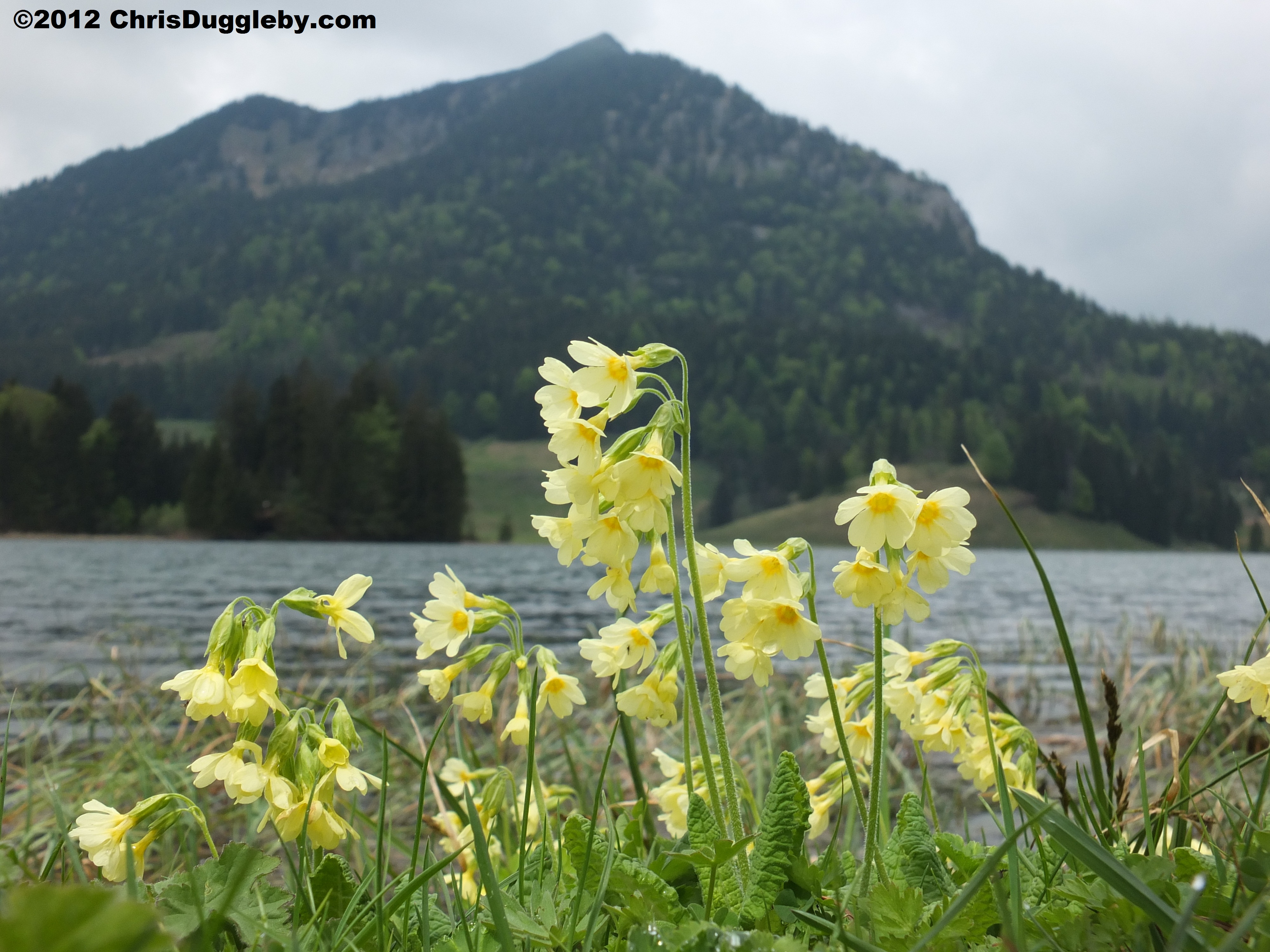
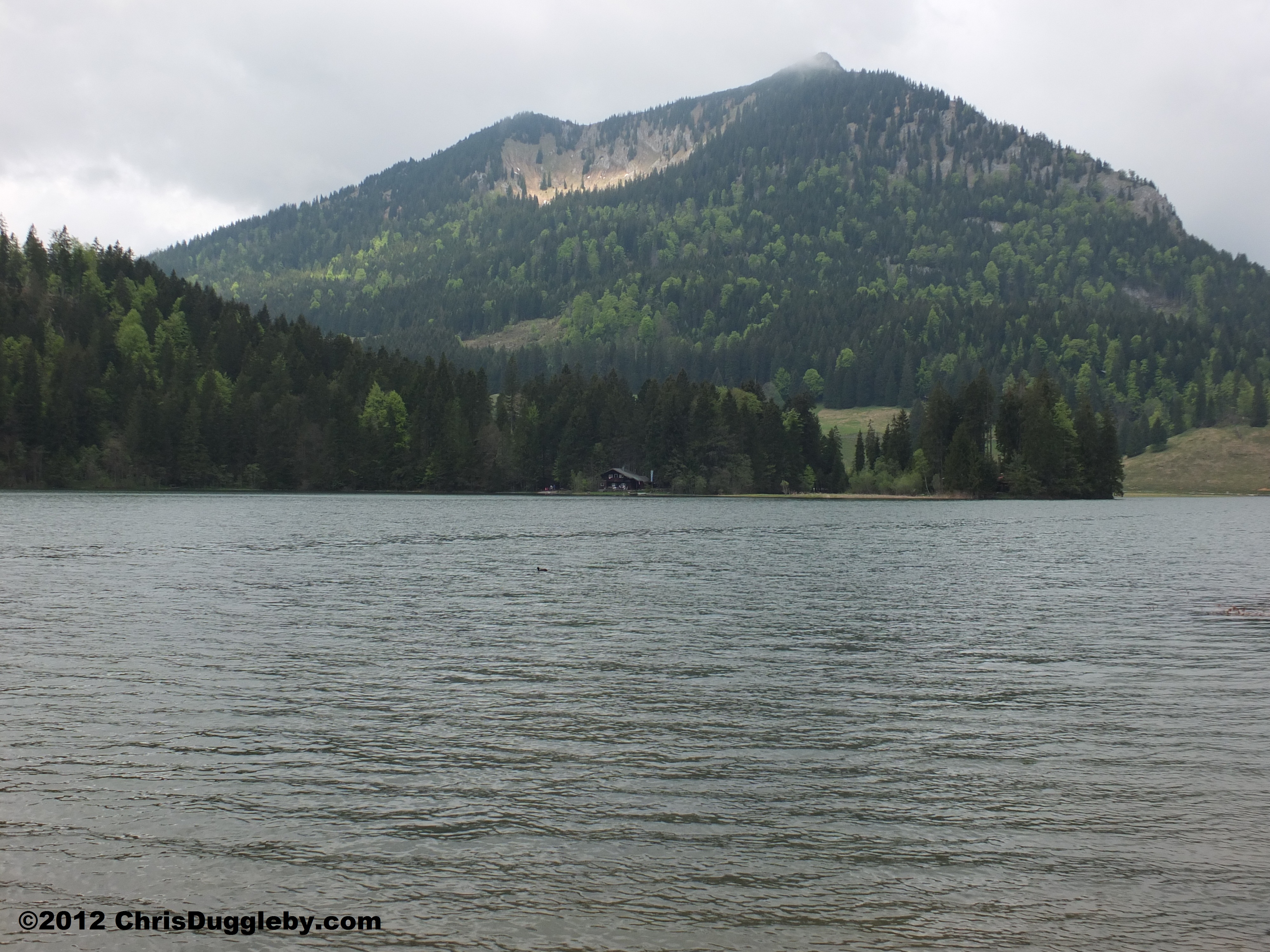
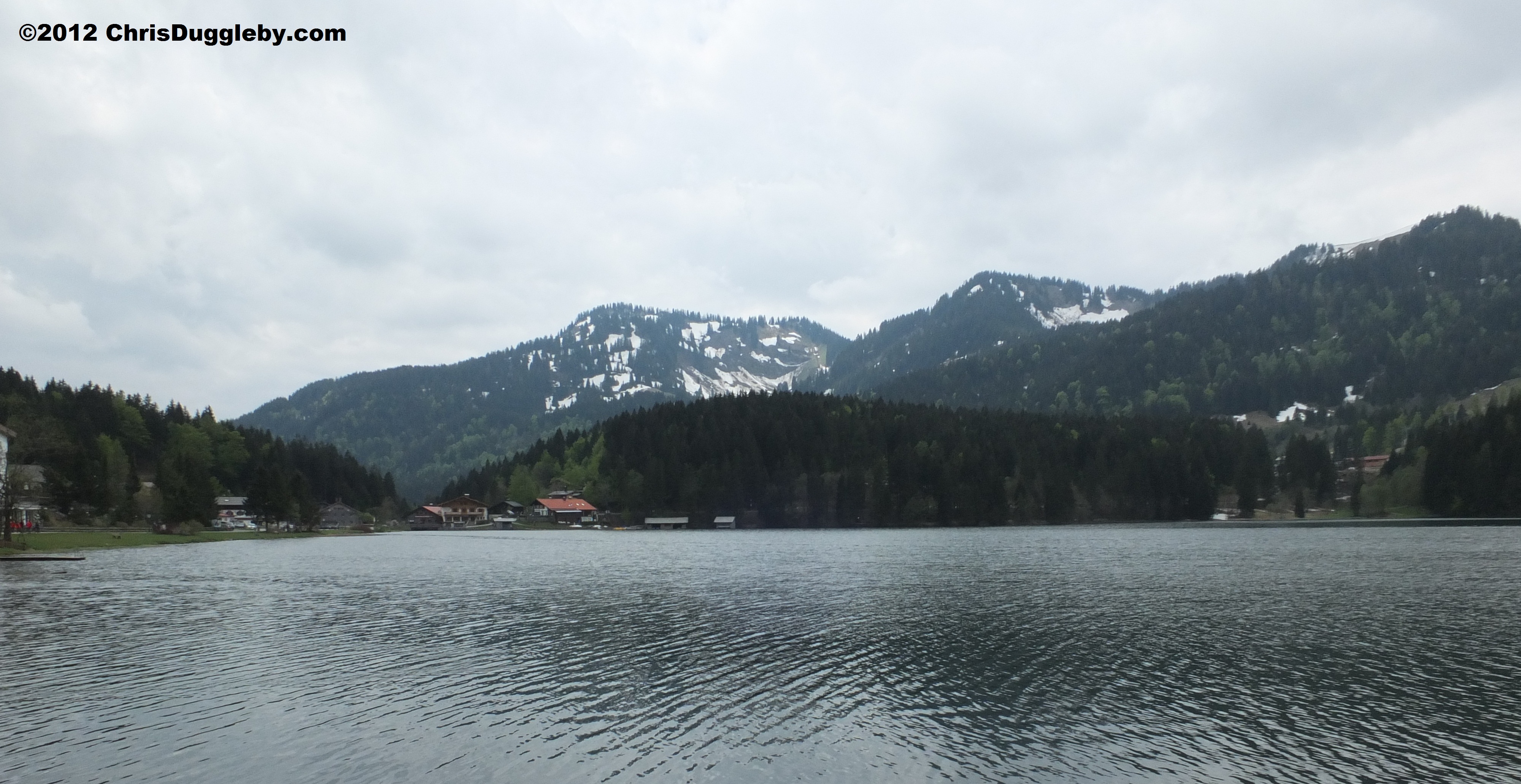
This week I would like to share with you some photographs I took during a visit to the Spitzingsee (Spitzing Lake). This is a little lake in the Alps not far from the German Austrian border. I have to admit to having a weakness for small mountain lakes ever since I spent some time as managing director of a plastics fabrications company in the heart of the Austrian Lake District. In the summer time I would rush off at the end of each working day and drive up to one of the lakes, high in the mountains. Although the water could be a little cool the scenery was exhilarating and after spending the day sorting out business problems it was fantastic to leave all the stress behind and get a little closer to nature.
So last weekend I was determined not to be put off by the overcast sky and the drop in temperatures (incredibly for May we had 31 C on the Friday which dropped to 8 C on the Saturday – a fall of 23 degrees!) and loaded my film crew into the car and set off for the Spritzingsee. I was not disappointed. I have added many of the photos to this blog entry (my production team also took some photos of themselves having fun – I will load these into RISKKO’s Dog Blog shortly). If anyone is unsure how to find the Spitzingsee and needs instructions please contact me via the ‘reply’ link at the bottom of this blog.
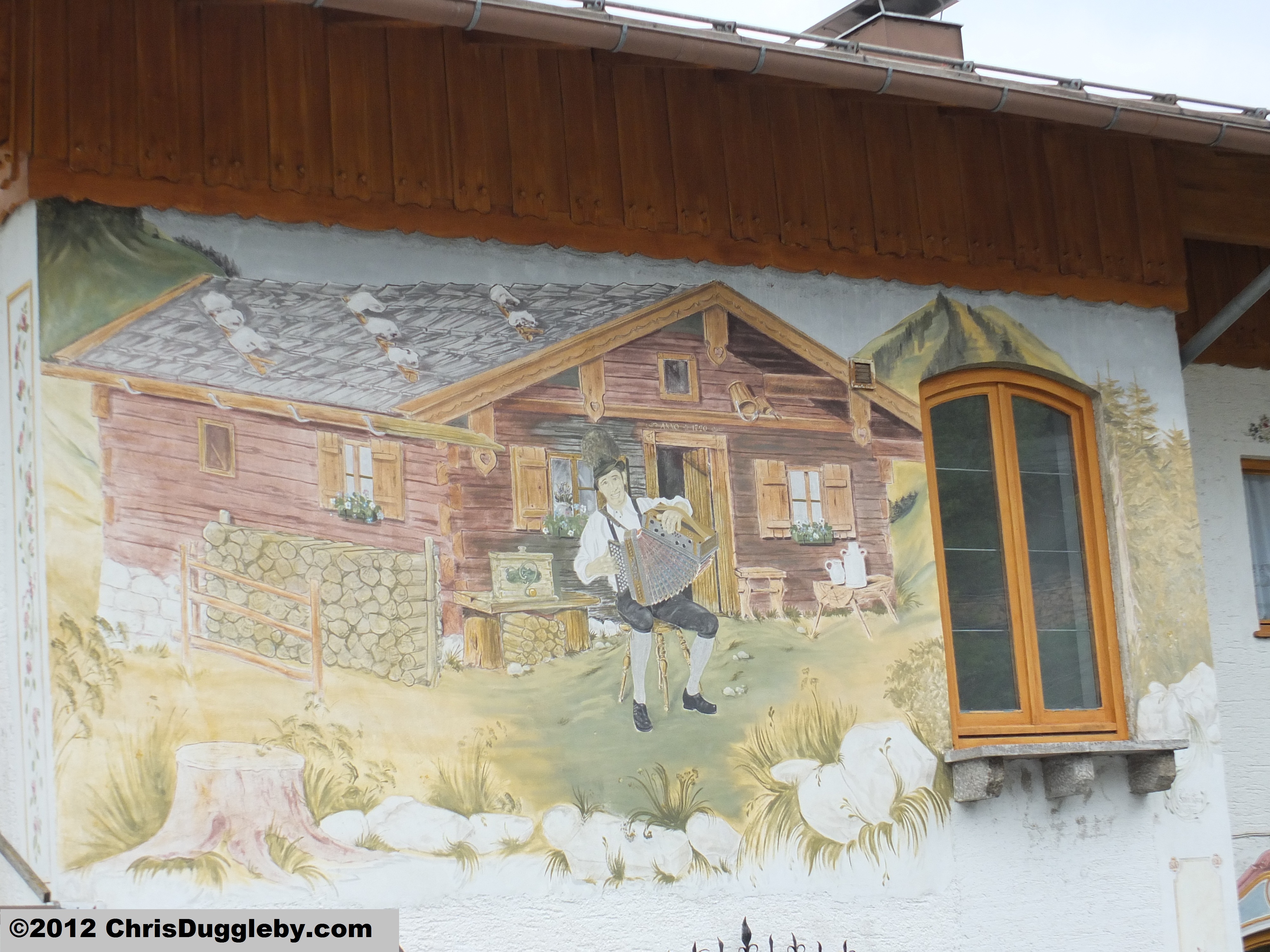
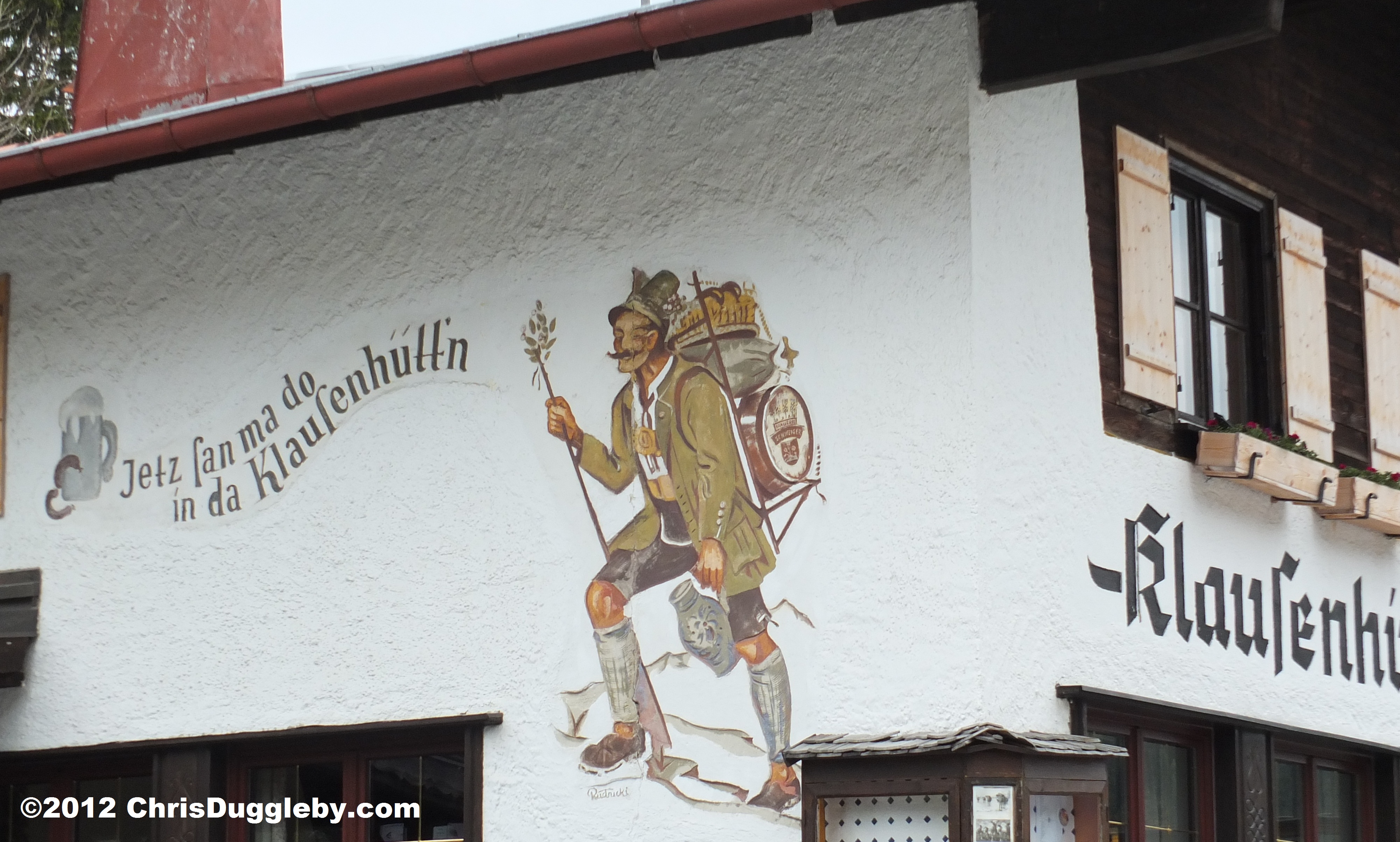
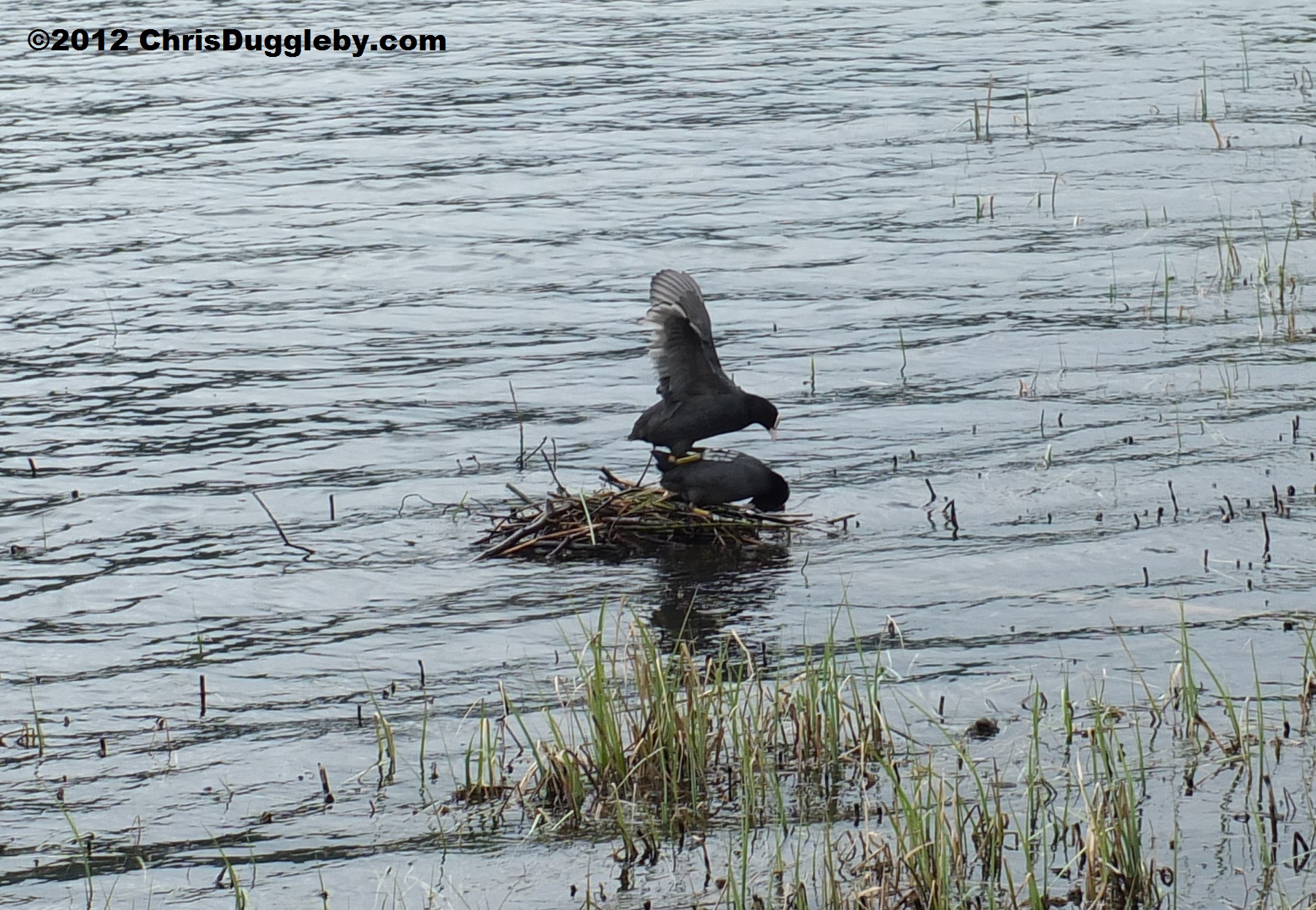
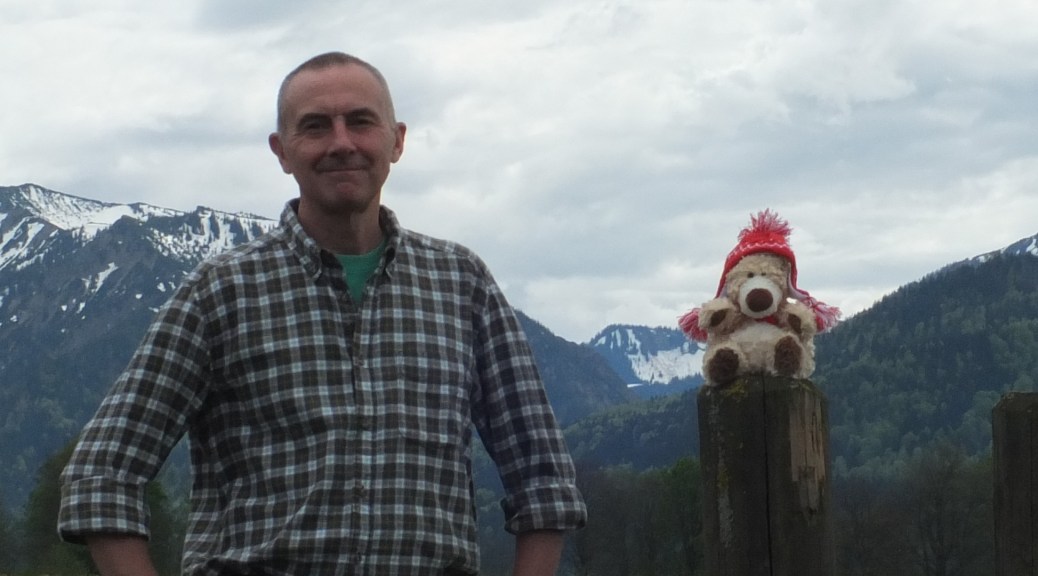
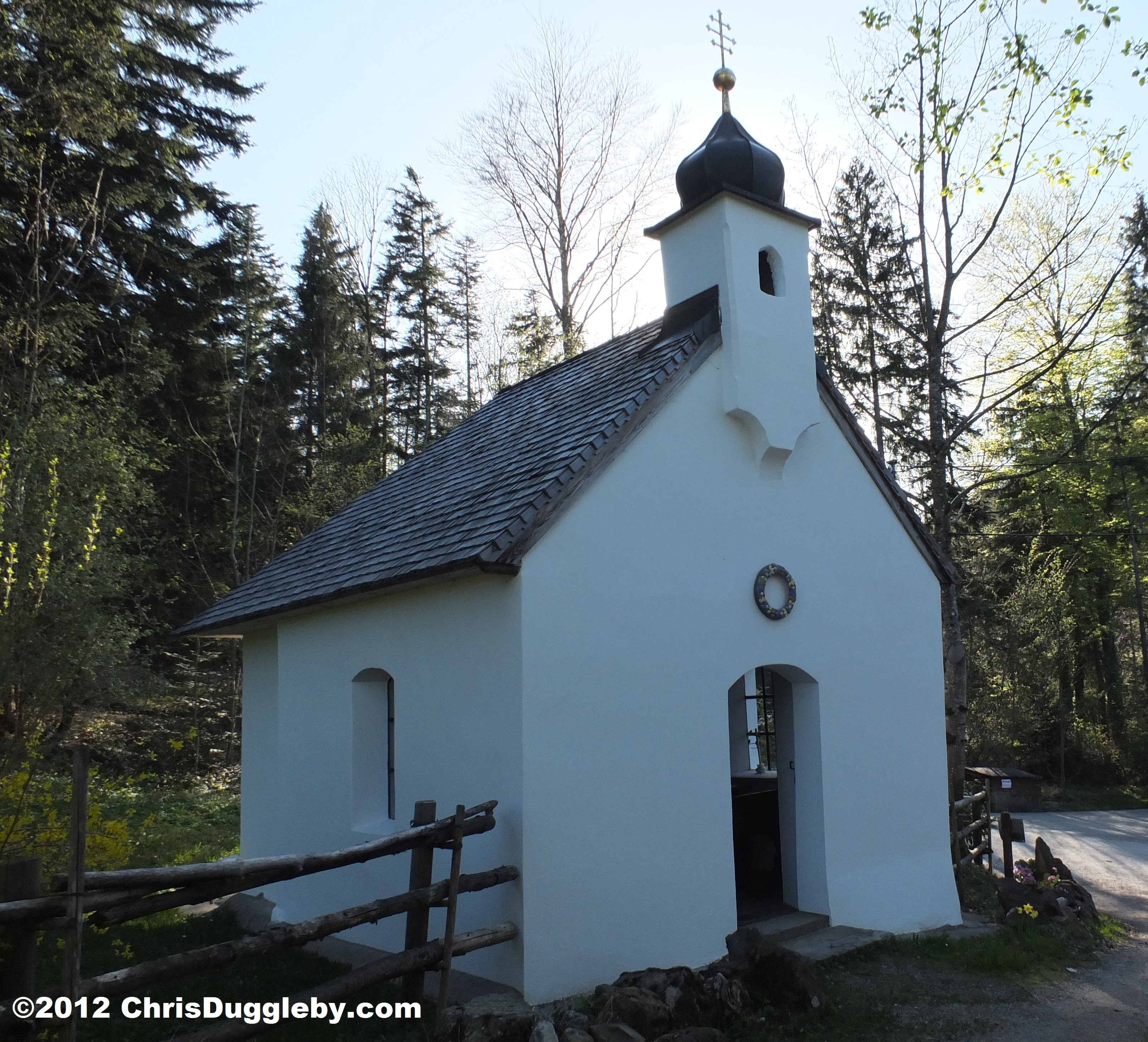
Spitzingsee Mountain and log cabinSpitzingsee Alpine RestaurantsAlte Wurzhütte A.D. 1720 on the SpitzingseeWurzhütte Restaurant on the SpitzingseeAlpine Wallpainting on Wurzhütte Restaurant SpitzingseeWallpainting of St George and Dragon on Wurzhütte Restaurant SpitzingseeWallpainting on Klausenhüttn Restaurant SpitzingseeSpitzingsee Alpine ChurchBird Building Nest in Spring on SpitzingseeBird Getting Back Massage from Partner on SpritzingseeSpitzingsee by Horse and CarriageSpitzingsee Panoramic ViewSpitzingsee in Spring – Camera Team
While you read the following article why not listen to my e-baroque compositions – just click on the box below:
or if techno music is more your cup of tea here are my techno/ambient compositions:
I hope you find the article below interesting…please visit chrisduggleby.com again.
(Die Marienkapelle: Klein aber Fein!)
Little forest chapel in the Alps
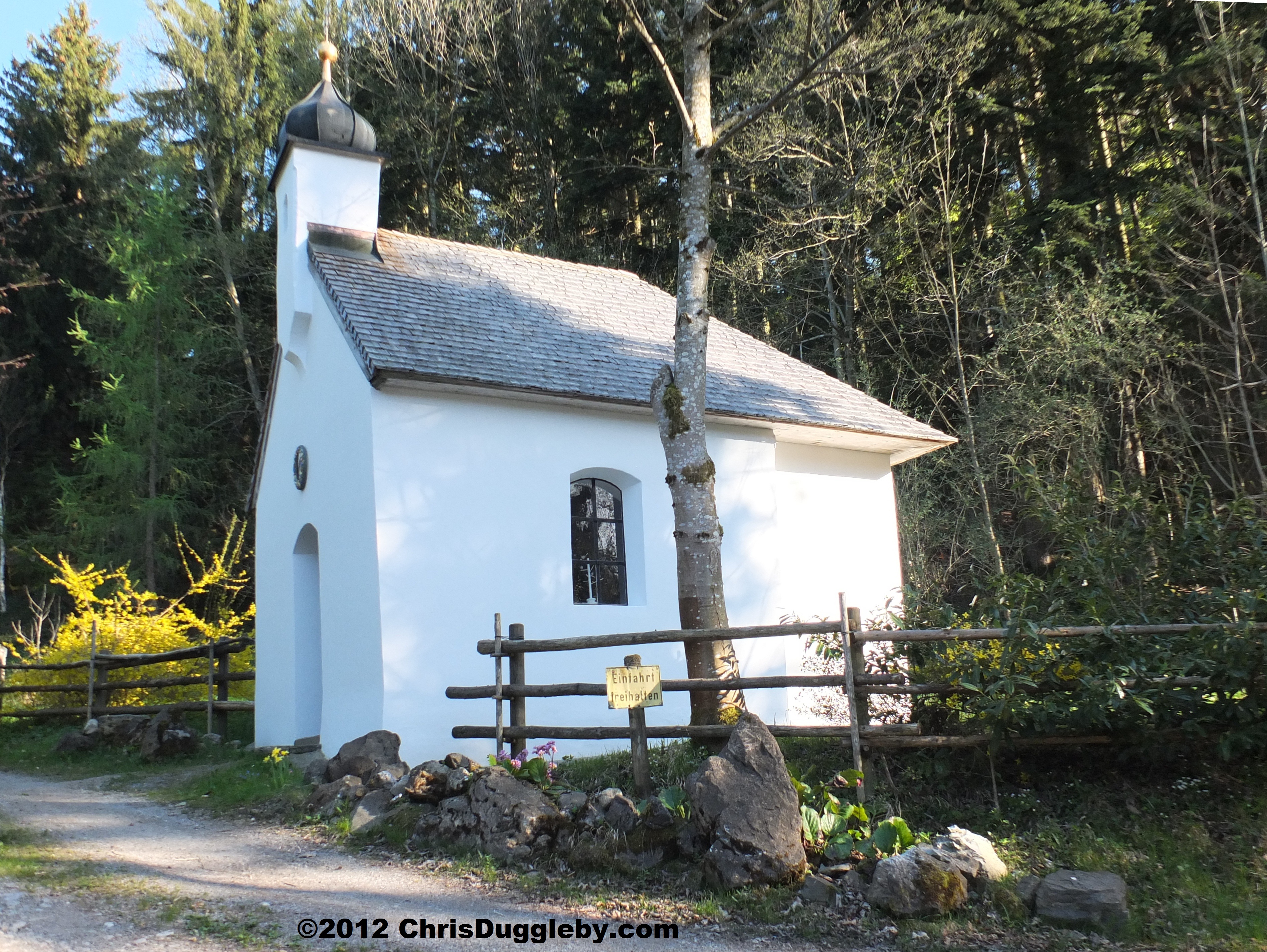
The subject of this week’s blog article is somewhat less dated than the English prehistoric burial mounds I described last week. My normal mountain trekking route on the edge of the Alps takes me past a place known as Thalhäusl. This is just above the alpine spa village of Bad Feilnbach. Here on the edge of the forest at the foot of the Schwarzenberg mountain is a lovely little chapel called the Marienkapelle.
Marienkapelle AD 1830 at the Forest Edge above Bad Feilnbach view from leftMarienkapelle AD 1830 at the Forest Edge above Bad Feilnbach view from right
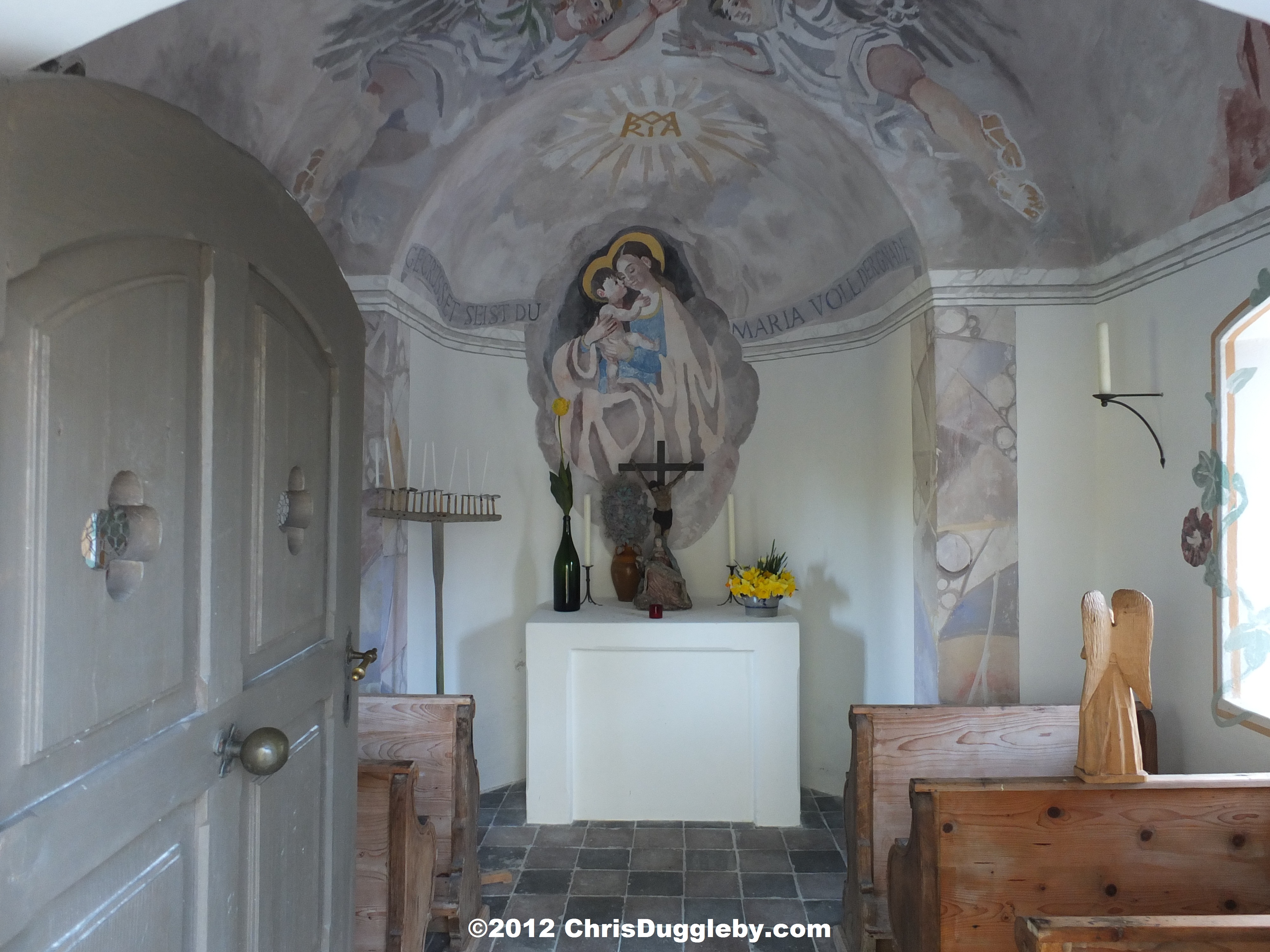
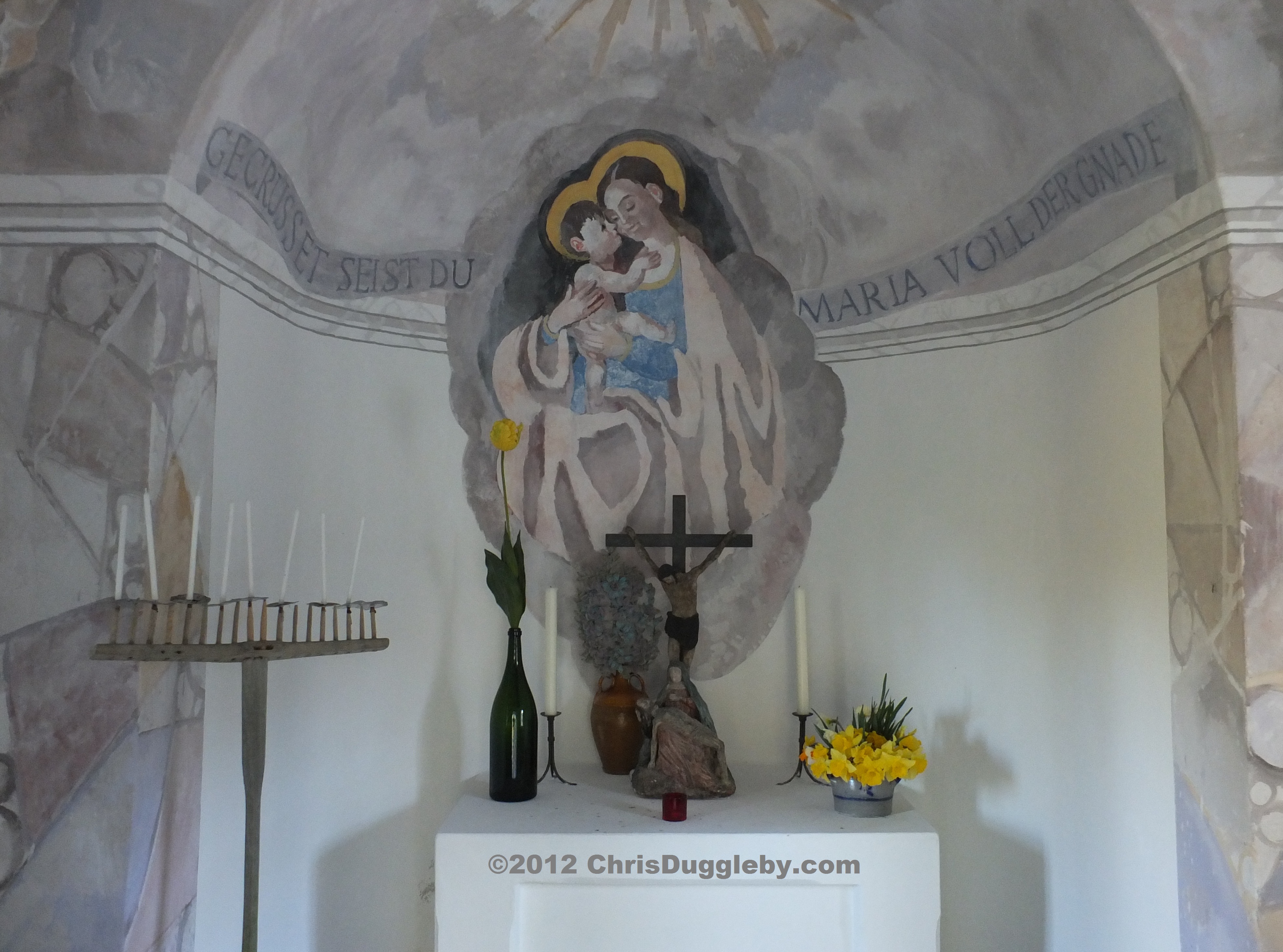
On one of my ‘mountaineering’ expeditions I happened to notice the door of the forest chapel was open so I decided to pop my head inside. I was amazed at the way this very small chapel was so beautifully decorated. The first thing I saw as I looked through the door was the altar. This was laid out with fresh flowers and behind the altar was a beautiful hand painted mural of the Virgin and Child
Marienkapelle AD 1830 at the Forest Edge above Bad Feilnbach: View through doorMarienkapelle: The altar
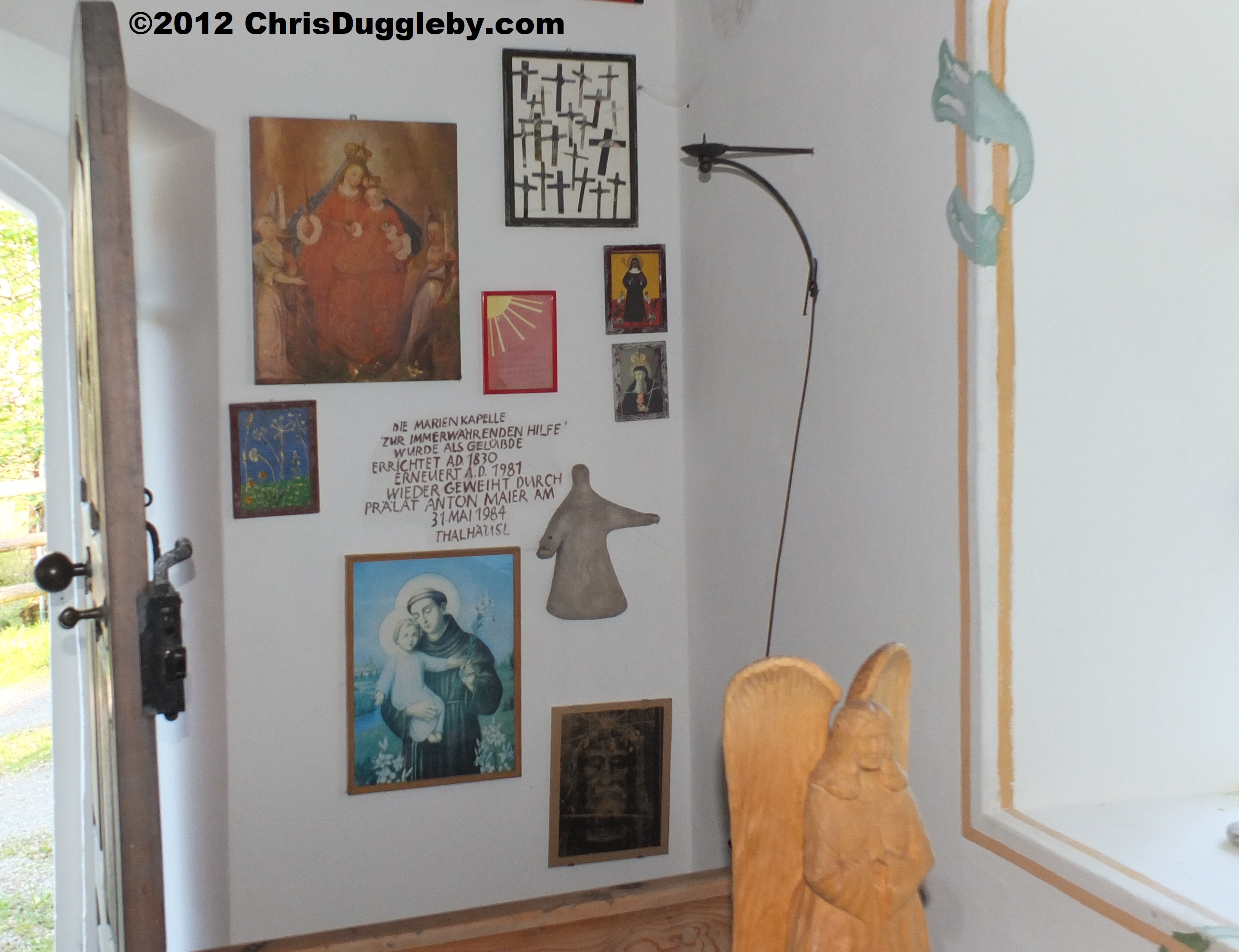
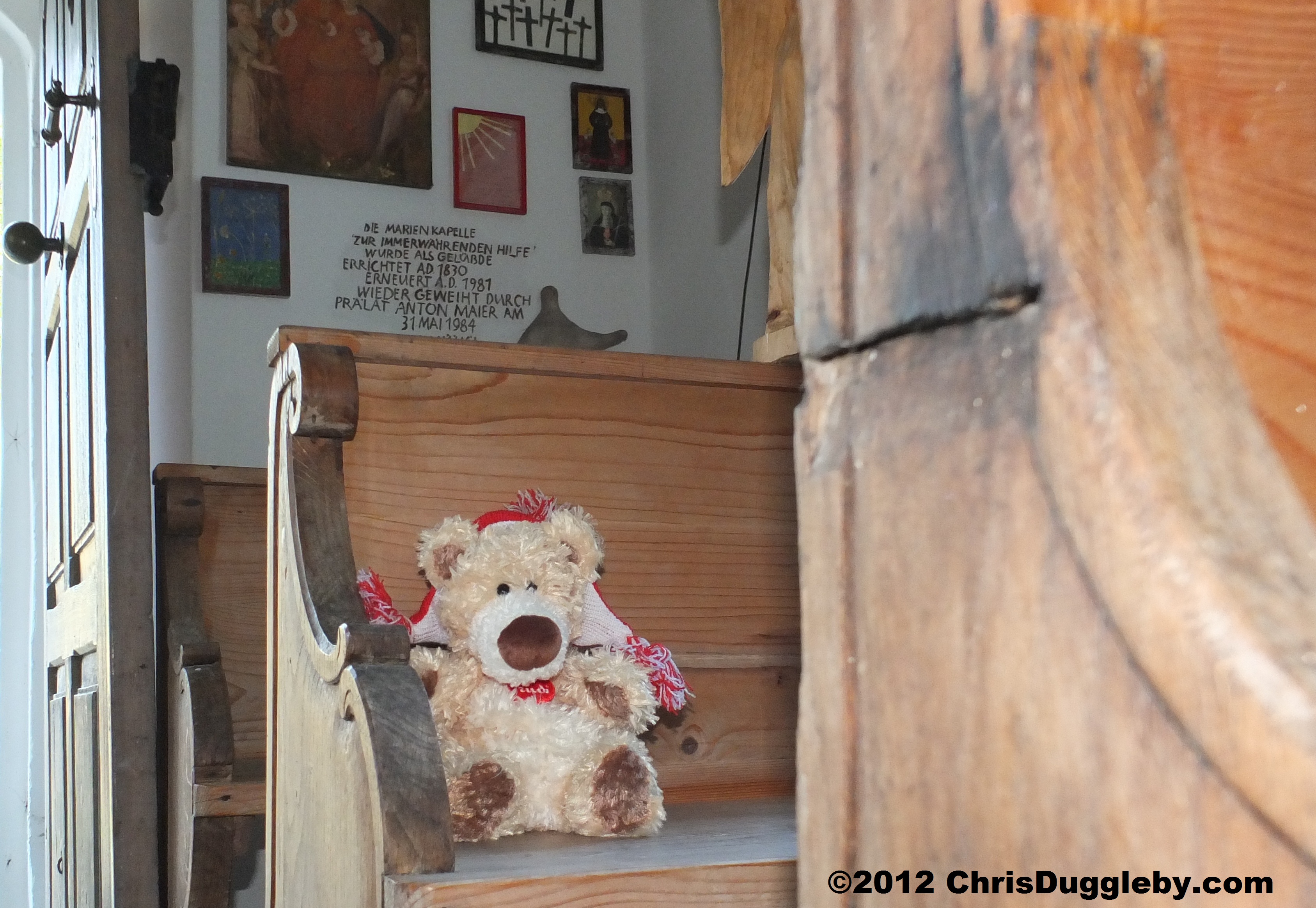
I walked up to the altar and admired the rear of the chapel. On the walls on each side of the chapel door were colourful pictures and on the left hand side there was some information about the history of the building. It was originally founded in 1830 when it was dedicated as a place of ‘perpetual help’. Most recently it was renovated in 1981 and again consecrated on 31st May 1984.
Above the door were some more small pictures, hanging together with religious and agricultural artefacts. There was also a rope to the bell which sat in the tower above the small chapel.
Marienkapelle above Bad Feilnbach: Rear wall above door
What surprised me the most were the beautiful murals on the ceilings to the left and the right of the door. On the left side facing the door was a wall painting of a lady in a traditional Bavarian dress (a ‘Dirndl’) and hat. She appears to be singing. On the right side ceiling was a picture of a man dressed in Lederhosen carrying a traditional local hat with a feather in it.
Marienkapelle ceiling fresco of lady singingMarienkapelle ceiling fresco of man in Lederhosen
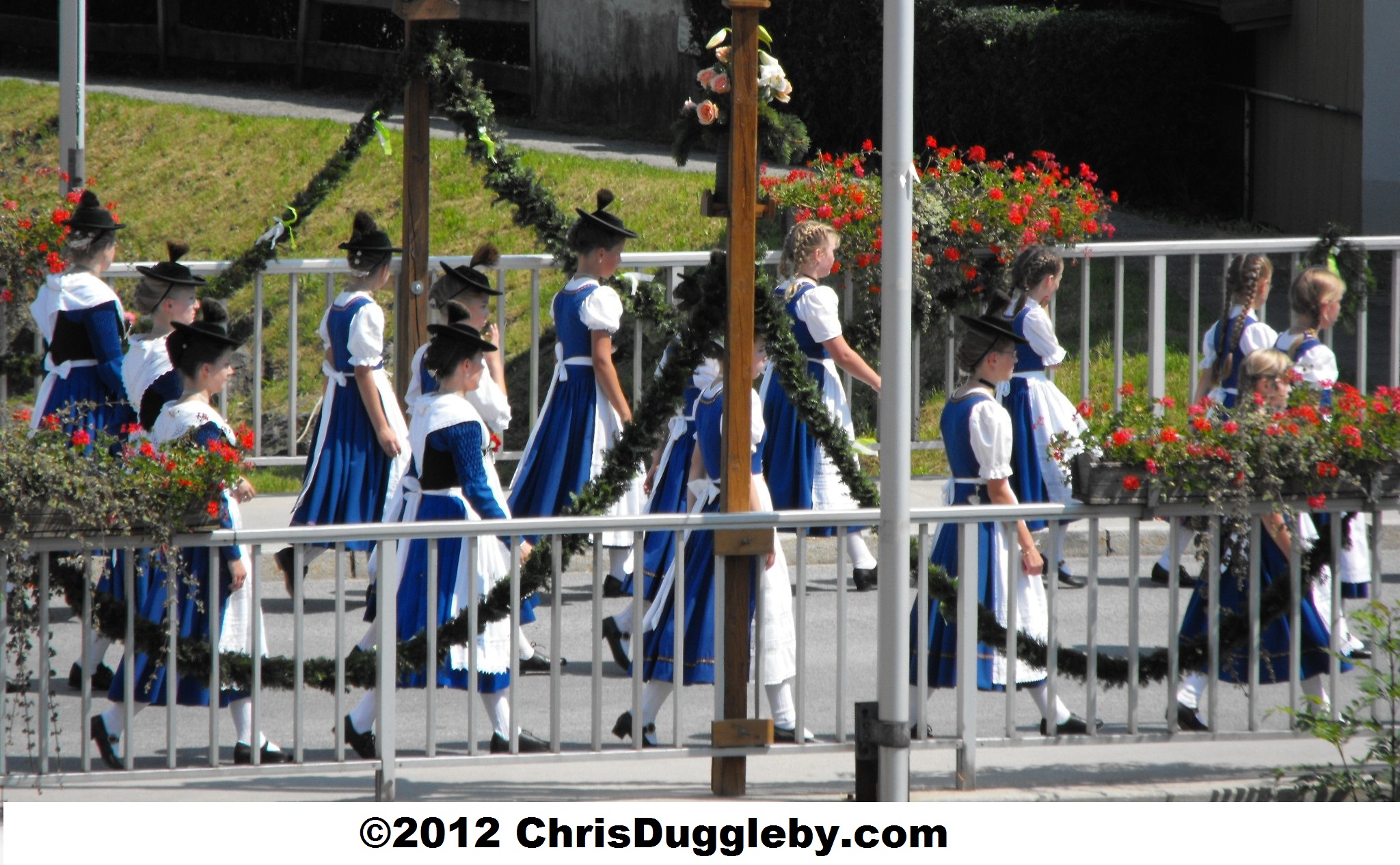
If you visit any of the local churches on a Sunday or during an important religious festival you will see many people dressed in these traditional clothes (collectively referred to as ‘Trachten’ or ‘Trachtenmode’). Sometimes there are processions in which hundreds of local folk dress in traditional clothes accompanied by marching bands. I have tried to capture some of these in the pictures below (sorry about the angle of the shot – I was leaning out of the kitchen window!). The location is Bad Feilnbach near the Bavarian, Austrian border.
Bad Feilnbach: Alpine Procession in Traditional Dress 1Bad Feilnbach: Alpine Procession in Traditional Dress 2Bad Feilnbach: Alpine Procession with Traditional MusicBad Feilnbach: Alpine Procession with Traditional Refreshments
By the way, if any of my regular visitors are concerned that I have not mentioned RISKKO the dog in this week’s article this is because he now has his own Dog Blog. In the last few days I have added some more pictures and stories about his latest adventures (and of course his videos!).
Marienkapelle at the Forest Edge: Small guest in the small chapel
I wrote a blog article a few weeks ago introducing the three prehistoric burial mounds or Barrows in Horsell common. If you are interested in that article please use the link at the bottom of this page. It also described the exact location of the barrows using satellite photography. In that blog I mentioned that I was sure there was a fourth significant prehistoric structure but at that time I did not have suitable photographs to describe it in more detail. Today as well as providing more photographs of the larger mounds I will present a better description of the fourth structure. In addition there are a number of other objects in the common which, because of their close proximity to the larger prehistoric barrows, could also be the remains of other ancient burials.
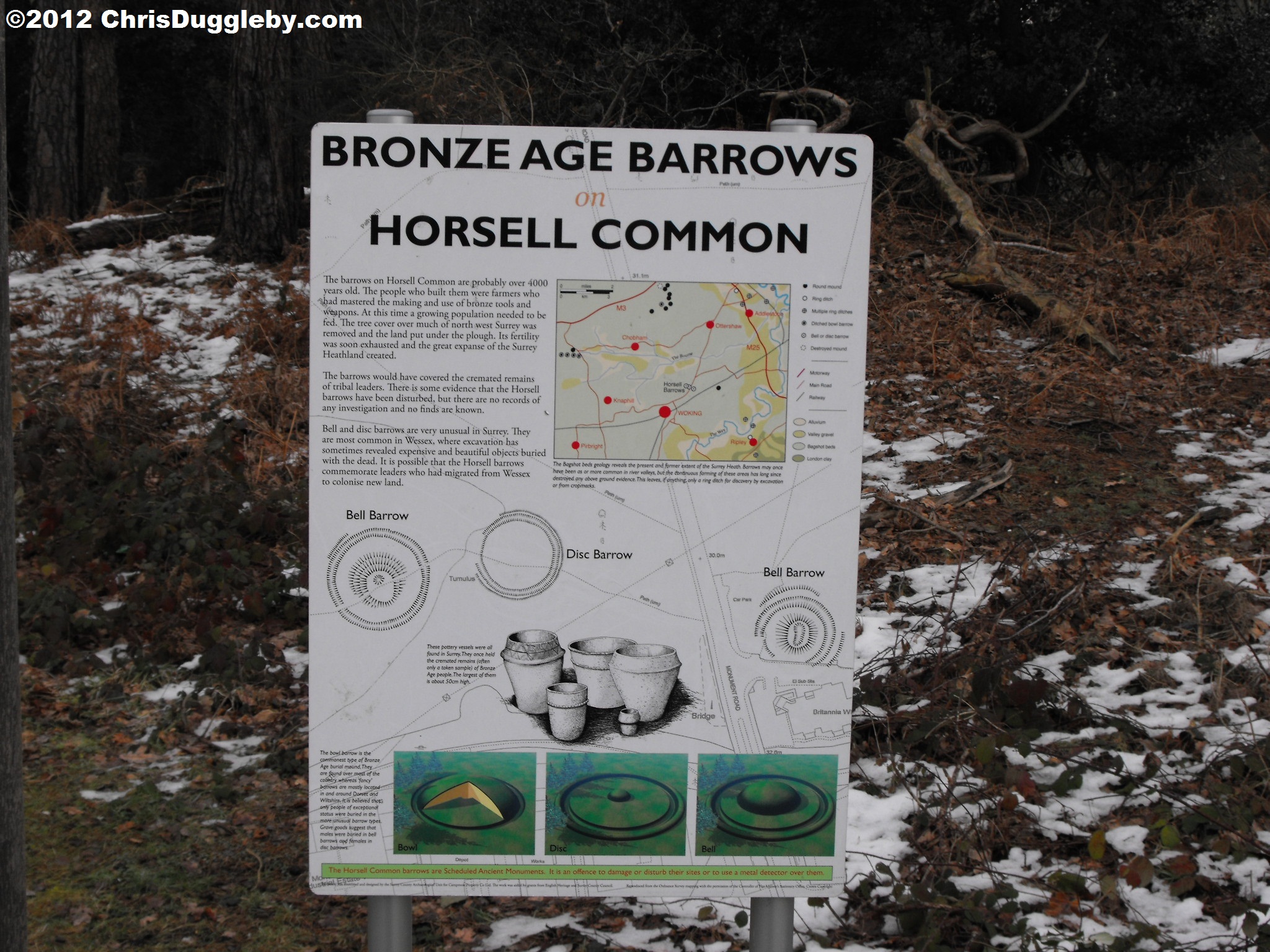
Horsell Common Archaeological Site Sign
Let me start with the sign at the entrance to the archaeological site. This describes the position of the three large mounds together with a summary of their history. If you click on the picture you should be able to increase the size to make it easier to read. Then just click over the left arrow on your search engine to return to this page.
The sign describes two bell barrows (the word bell refers to the typical shape of such prehistoric burial mounds) with a disc barrow between them. The disc barrow is quite hard to distinguish on the ground due to the vegetation which has grown over it. The satellite photo in my earlier blog article more clearly indicated the site of the disc barrow as a circular clearing in the trees adjacent to the larger more obvious bell barrow.
The photograph below is of the large bell barrow.
Largest Prehistoric Burial Mound in Horsell Common
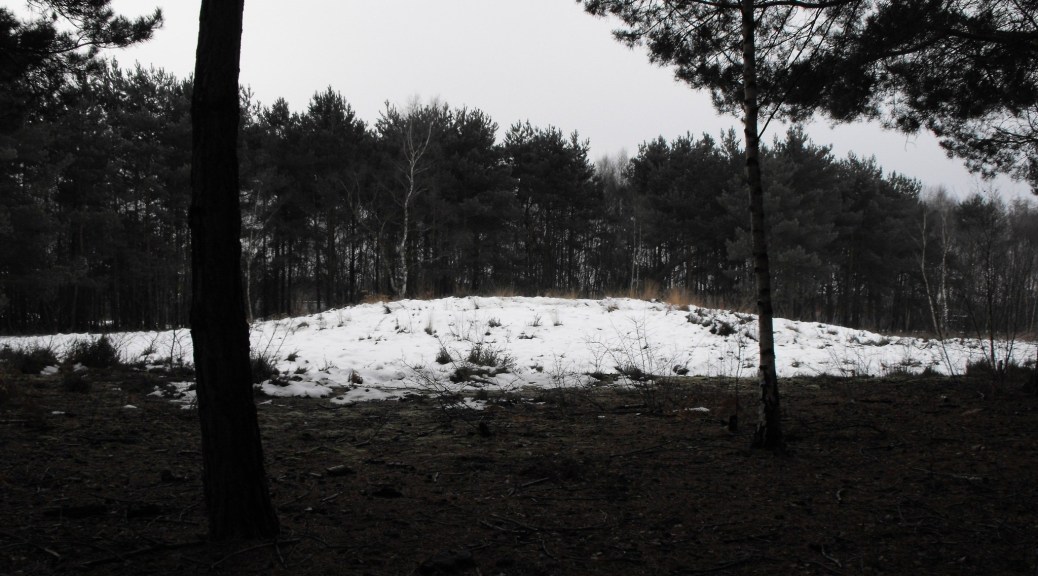
At the very top of this article is a picture of this barrow taken when it was covered in snow which helps to emphasize its profile. The photograph without snow was taken from the opposite side at the end of April 2012 and also shows the old path which went over the top of the barrow. This path crosses over the burial mound close to a point where it has clearly been excavated, many years ago, possibly by treasure hunters. I have found no record of any formal archaeological excavation or finds here. There was however a written description of the location of the two bell barrows as early as 1718 by the antiquarian John Aubrey in his ‘History of Surrey’.
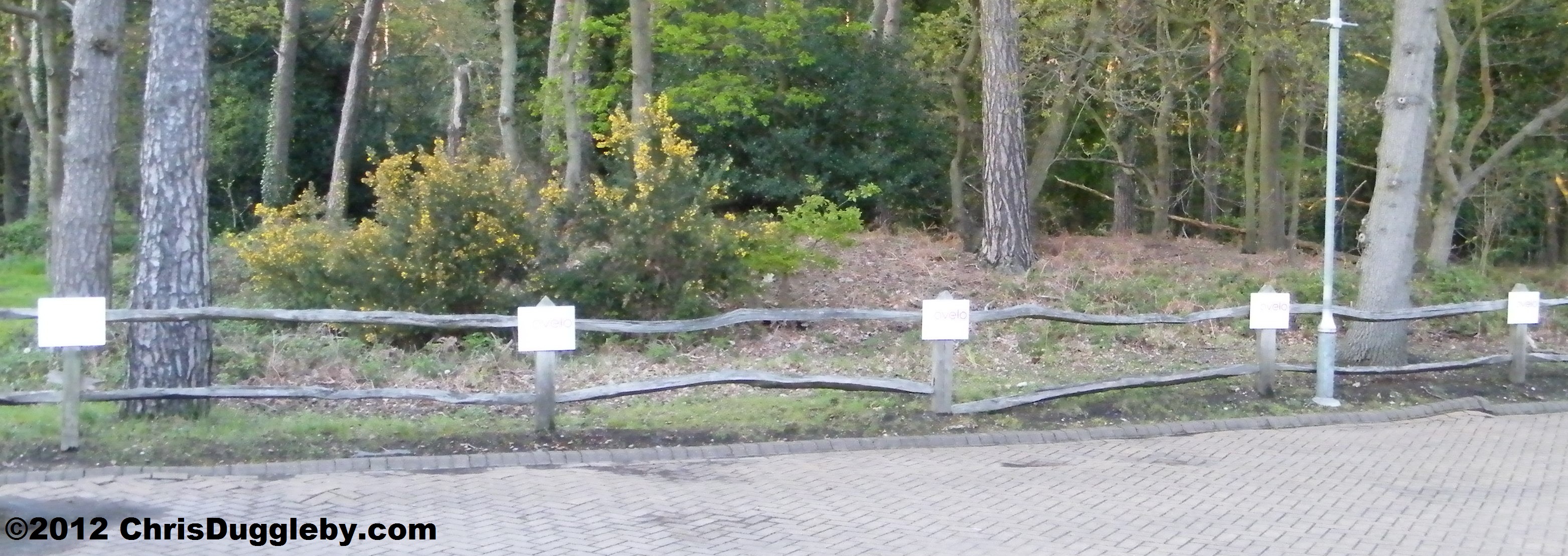
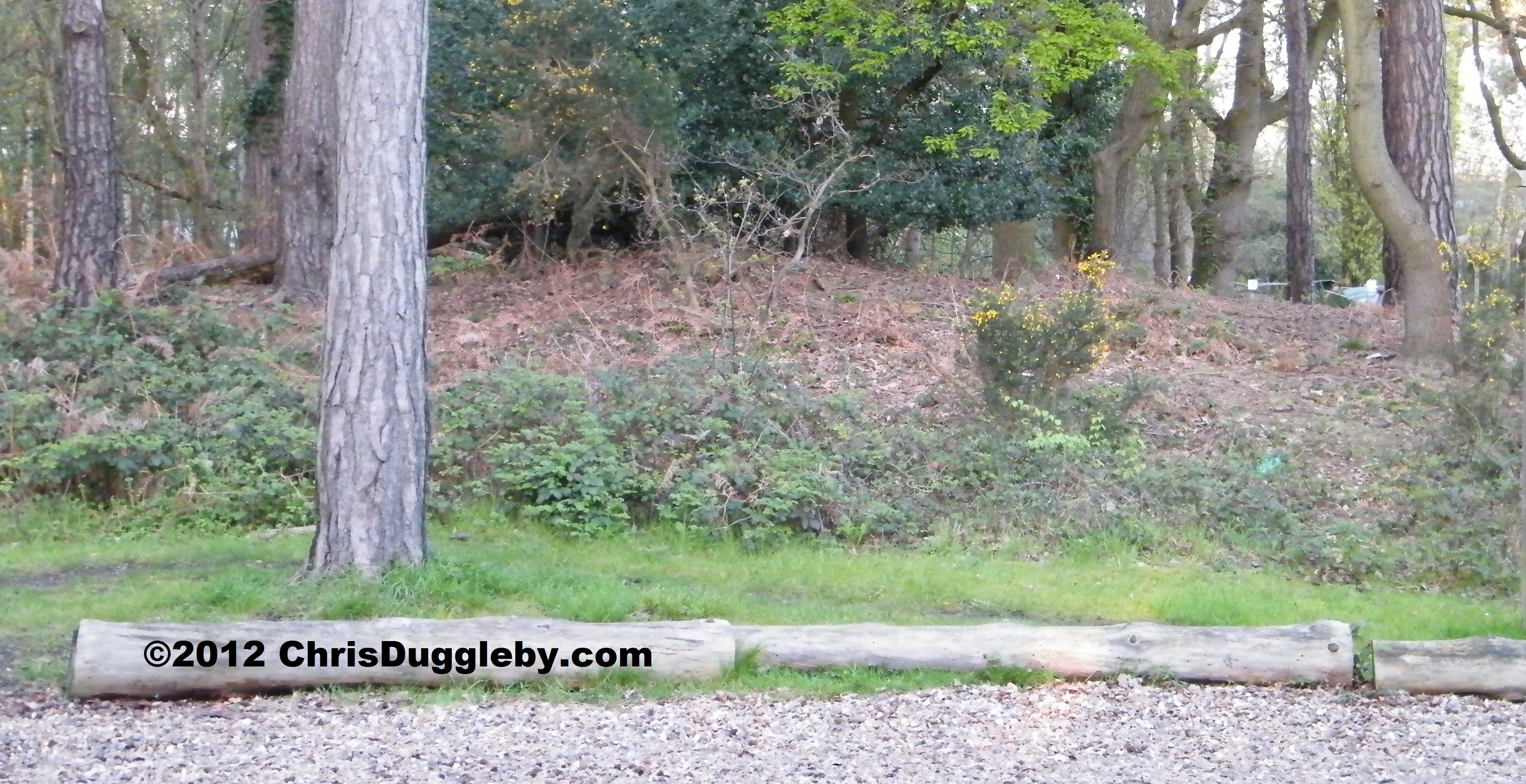
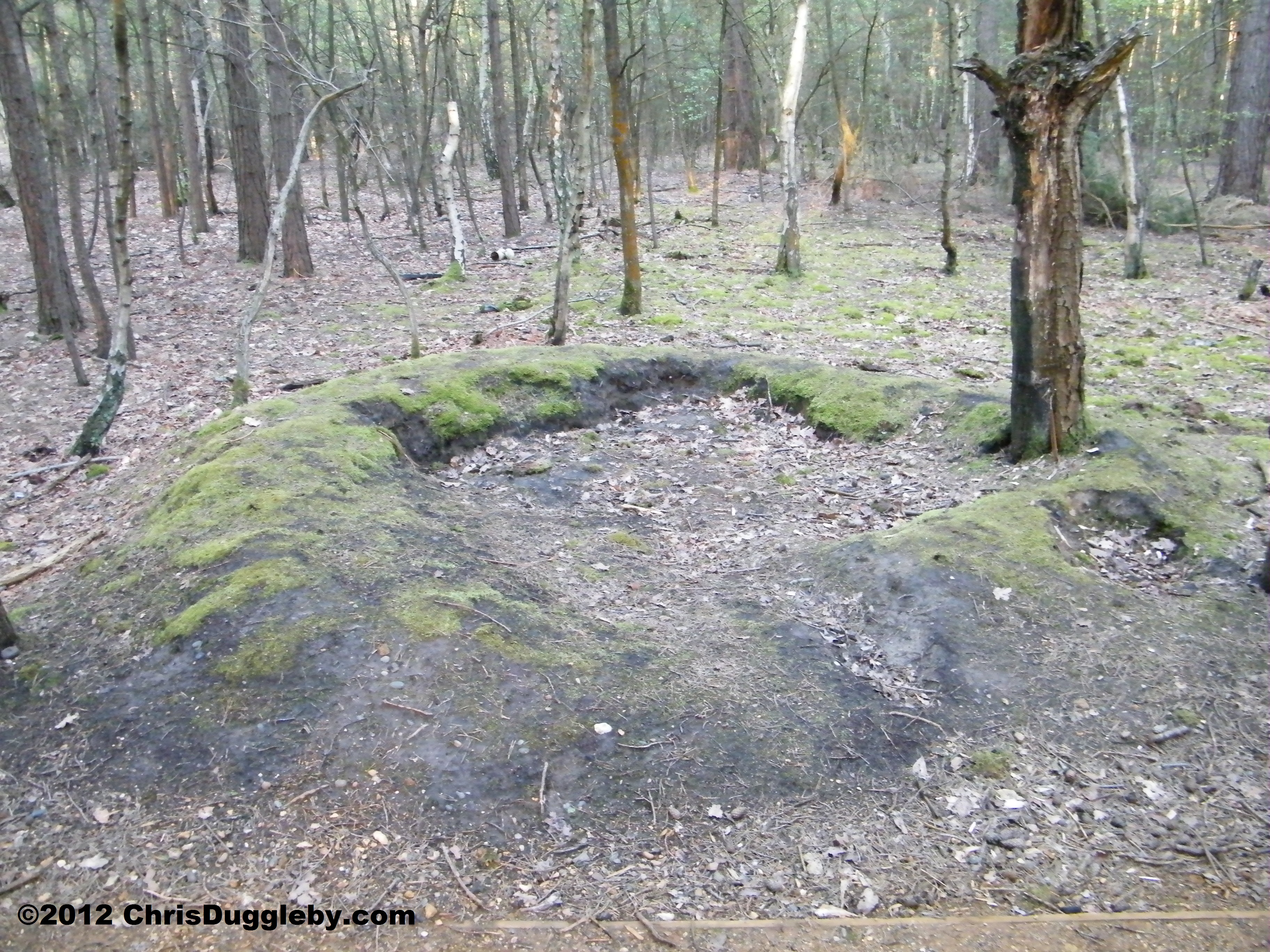
The other bell barrow on Horsell Common is more overgrown making it harder to distinguish the exact size and shape. It also appears to have been disturbed in the past. This mound is adjacent to the Monument Road car park, directly behind the sign in the photograph above. The following photographs were taken from three different positions.
Horsell Common Bell Barrow Nr 2 Rear viewHorsell Common Bell Barrow Nr 2 Right or Office sideHorsell Common Bell Barrow Nr 2 Front or Road side
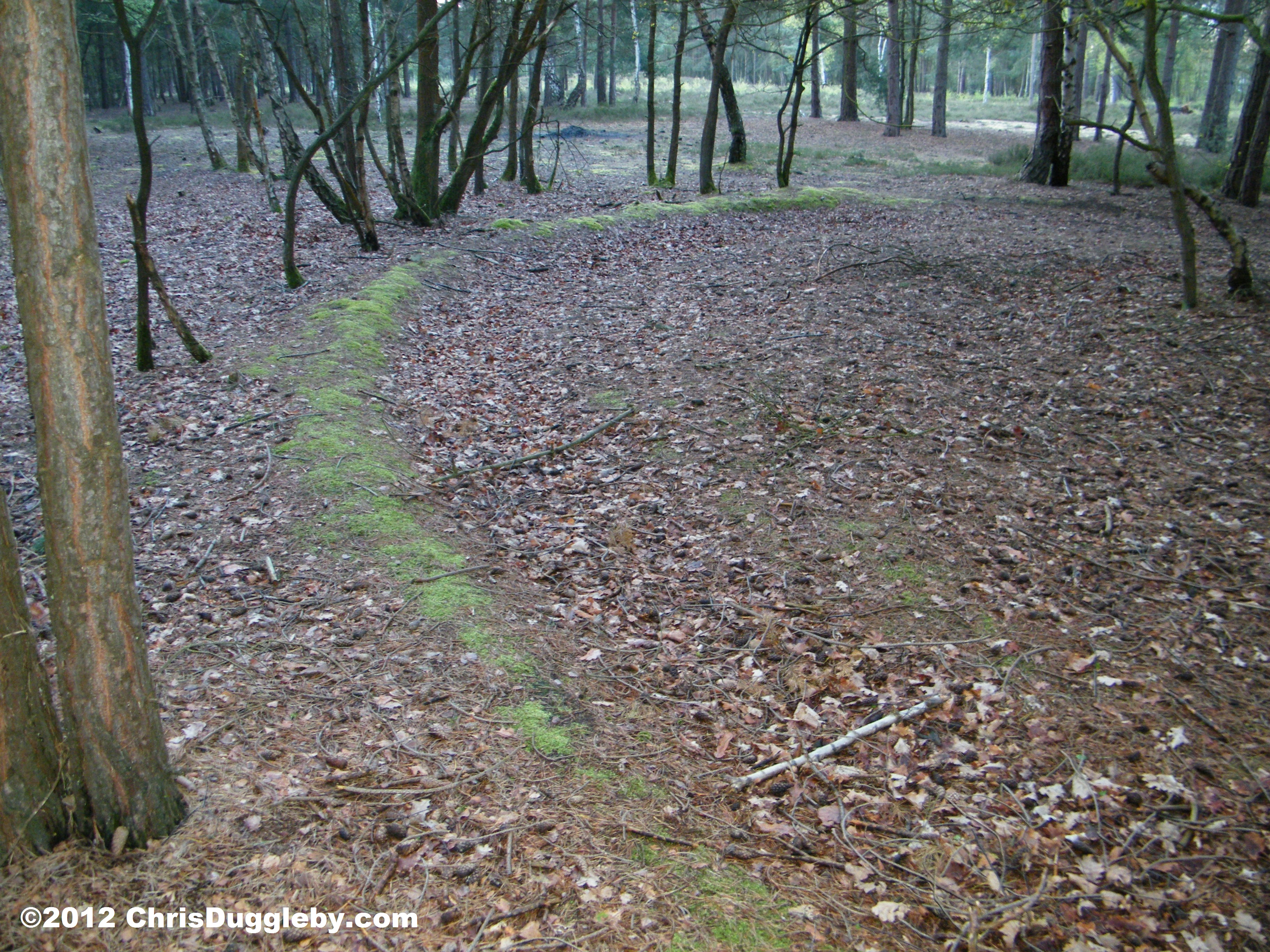
Moving now to the other structure which I came across a couple of years ago. If you follow the path over the road past the two other barrows and keep going in roughly a straight line you will come across a circular raised ridge where the vegetation is clearly different to that which is growing nearby. This is not as large as the other structures and there is no obvious large mound in the centre. Therefore I would presume it is more likely to be the remains of a disk barrow.
Fourth Prehistoric Burial Barrow in Horsell Common
The following three photographs are taken from different positions to illustrate its shape and size. Similar burial grounds in Wiltshire can include ten or even more barrows and therefore it would not be unusual to find more than three large barrows here. Since the people who built these structures lived from agriculture it seems unlikely that they would used more fertile land for their burial grounds and the satellite photographs from my earlier blog article highlight that even today there is very little vegetation able to grow in this clearing. Much of the rest of the common nearby has been repopulated by trees: it is presumed the stone age farmers cleared the original forests for agriculture but that with time the poor quality of the soil caused it to revert to heathland. In fact it is probably the very unsuitability of this location for farming that has helped to ensure that we can still identify these structures today, despite being around 4000 years old. In other locations, where the soil is more fertile, agriculture has destroyed the remains of many ancient burial sites.
Horsell Common Barrow Nr 4 Left sideHorsell Common Barrow Nr 4 Right sideHorsell Common Barrow Nr 4 Rear side
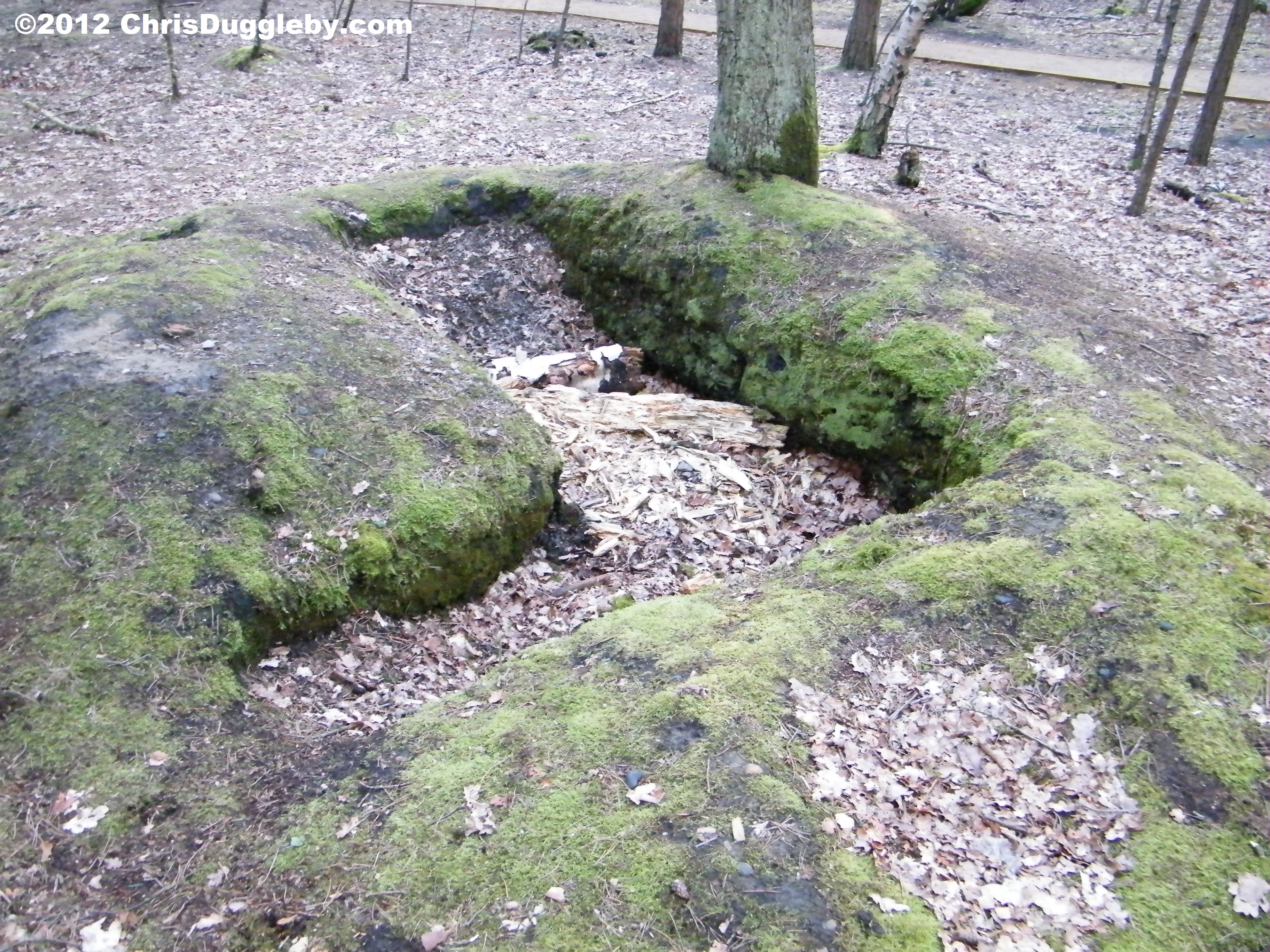
Finally I would like to include some other photographs taken in this area to illustrate other examples of what I believe could be ancient burial sites. These three structures appear to be typical of barrow type mounds and all show signs of disturbance, again possibly by treasure hunters or amateur archaeologists.
Horsell Common Disturbed Mound AHorsell Common Disturbed Mound BHorsell Common Disturbed Mound CHorsell Common Disturbed Mound C rear view
The last photograph is of another smaller circular structure which may well be disc barrow which has been overgrown by trees. The circular markings in the ground vegetation are still quite distinct.
Horsell Common Smaller Ring Structure Near Large Barrows
The Horsell Common Preservation Society has recently laid down a 1.2 km circular easy access trail which starts and finishes at a new car park opened on the side of monument road where all except for one of these structures can be found. This means that it is quite easy to stroll through this part of the common (called Woodham Common) and see for yourself the prehistoric burial sites – perhaps you may even find some other archeological treasures that have not yet been documented.
Here is the link to my earlier blog which has satellite photographs and also links to sites with more information about Ancient British burial structures. If you require more help finding any of these structures or have some interesting prehistoric information of your own please contact me via the comments box below.
Chris Duggleby,
6th May 2012
Horsell Common Preservation Society Welcome Sign Near Prehistoric Britain Site
If you like this kind of news there are plenty more exciting articles on my Alpine Press contents page which you can find here. Why not add this site to your browser favourites or subscribe to get regular updates?
While you read the following article why not listen to my e-baroque compositions – just click on the box below:
or if techno music is more your cup of tea here are my techno/ambient compositions:
I hope you find the information below interesting…please visit chrisduggleby.com again.
If you have any recommendations about how this site could be improved please do not hesitate to let me know using the comments box below. Thanks! Chris.
This week we had a very important day with regard to beer, dragons, authors and a singing cow called Uddele (not to be confused with Adele). The day was 23rd April. Let me start by explaining its significance for beer.
On 23rd April 1516 the Bier Reinheitsgebot or German Beer Purity Law was passed in the Bavarian town of Ingolstadt (this law was originally proposed in 1487 but they need a bit of time to think about it). The law stipulated that German beer could only be made from water, barley and hops and must be priced between 1-2 Pfennig per Mass(if you have been to the Munich Beer festival you will appreciate that a mass is a rather large glass – and the price has gone up!).
Advertisement for Rosenheim Beer first produced in 1543
In those days people didn’t realise that yeast was essential to the fermentation process. We had to wait until 1860 for Louis Pasteur to prove that fermentation was caused by living micro-organisms. Prior to his discovery brewers knew that a successful brew benefited by adding the sediment from a previous fermentation to the new batch. The yeast organisms were transferred in this sediment and quickly reproduced, causing the new batch to ferment. Yeast could find itself into the beer mix even if it wasn’t added through the ‘old’ sediment when the brewer exposed the vats to the surrounding air. This would allow natural yeast and bacteria from the atmosphere to fall into the mix, start replicating and ferment the ingredients.
The Beer Purity Law was introduced in Bavaria to stop brewers competing with bakers for wheat and rye in order to ensure that bread remained affordable for the common folk. When the States which now make up Germany became unified in 1871 the Bavarian State insisted that the Beer Purity Law must be applied throughout the country as a precondition of their membership. This led to the dominance in Germany of Pilsner type beers and some of the more exotic local beers like the northern spiced or cherry beers became extinct (although they flourished over the border in places like Belgium). Needless to say there were some brewers who refused to be pushed around by the Bavarians. As a result you can still enjoy a Koelner Koelsch or a Duesseldorfer Altbier if you visit Cologne or Duesseldorf. Long live beer diversity!
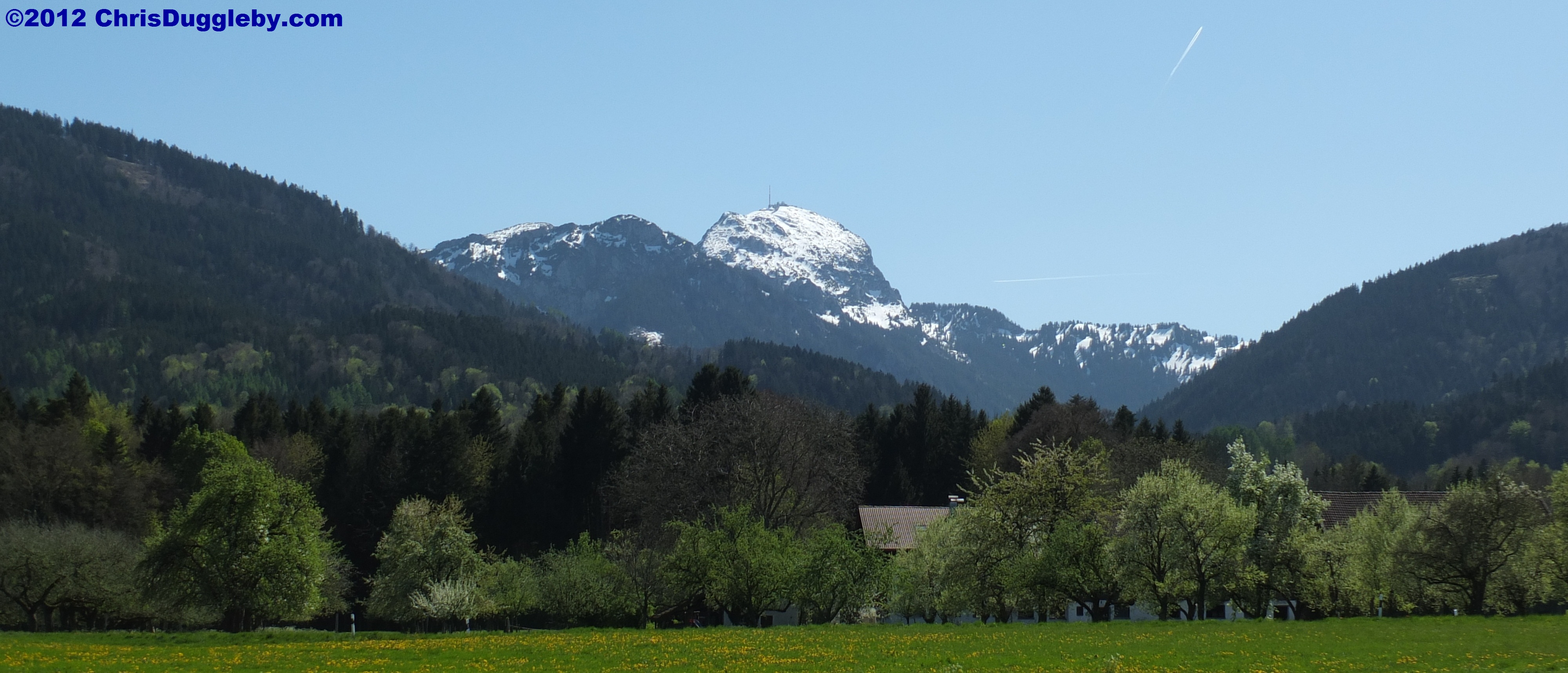
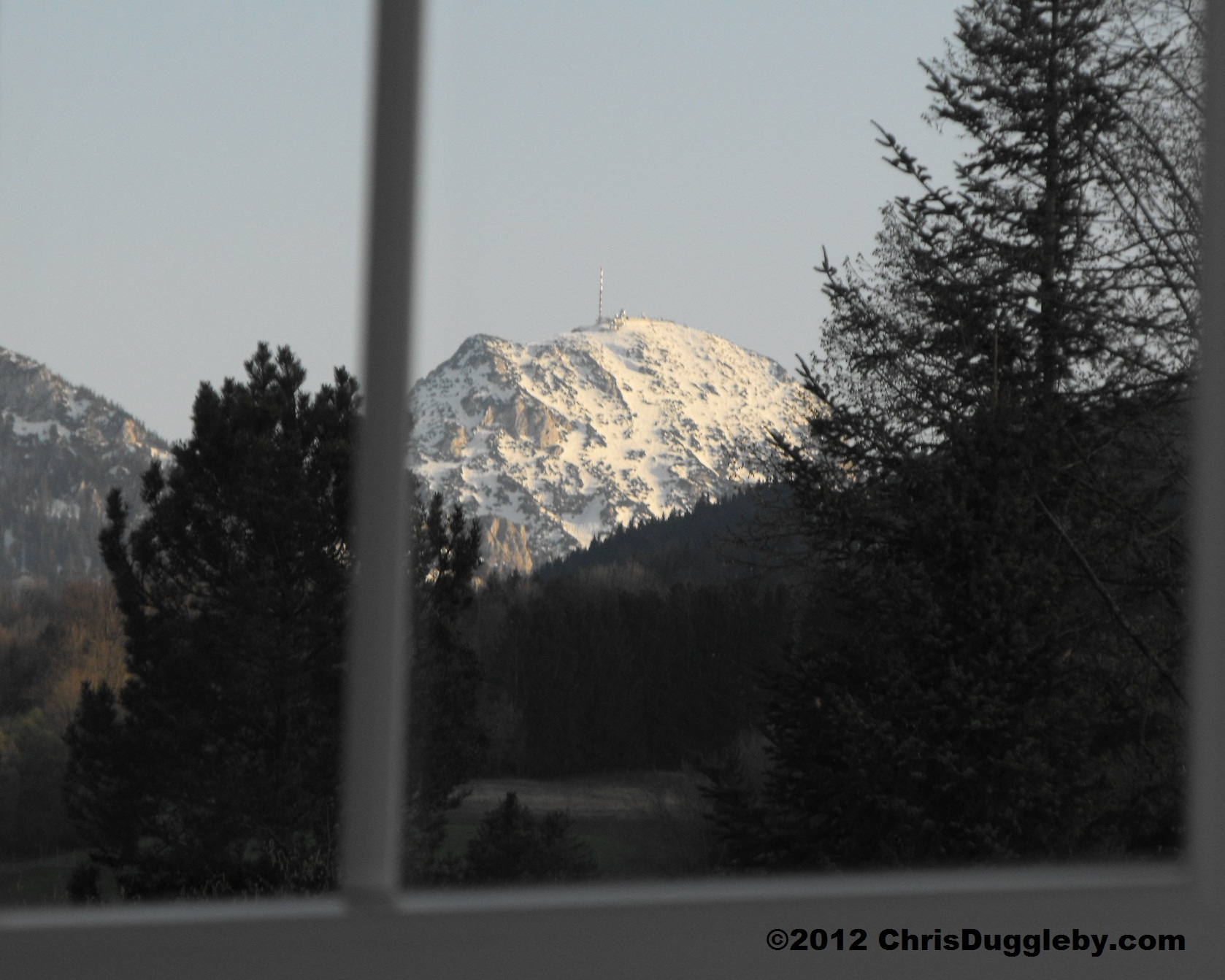
Alpine view in April (Wendelstein mountain overlooking Bad Feilnbach in Bavaria)
The original beer purity law was later succeeded by the Provisional German Beer Law which allowed additional ingredients to be added like yeast, wheat malt and cane sugar (but prohibits the use of unmalted barley). The German Beer Law still applies to all domestically produced beers although under EU legislation it is now possible to import beers made from other ingredients.
So next time you visit the Munich Beer Festival (the Oktoberfest which confusingly starts in September) just remember that the 23rd April 1516 was when the brewing rules where first laid down (and also remember to book your hotel rooms well in advance for the 500th birthday of beer in 2016!).
Alpine House Wall Pictures 1 St George
Today when I came down from taking RISKKO for his afternoon mountain walk I noticed a painting on the wall of one of the houses which reminded me of another reason to celebrate 23rd April. It is St George’s day and the painting was of a soldier on a horse fighting with a dragon. In the year 303 George, an imperial guard of the Roman Emperor Diocletian, was decapitated in the city of Nicomedia for refusing to renounce his Christian faith. His body was then returned to Lydda in the Holy Land, the country of his birthplace where the Christian community honoured him as a martyr.
During the reign of Constantine (AD 306-337 the first Roman emperor to convert to Christianity) a church was build in Lydda and was consecrated to a man of the highest distinction. This was almost certainly George (or Georgius – in Latin). In AD 494 George was canonised as a saint by the Pope (Gelasius 1). The church in Lydda was destroyed in 1010 but was rebuilt and dedicated to St. George by the Crusaders. This was again destroyed in during the 3rd Crusade (1189-1192 – yes the crusade fought by Richard the Lionheart, and perhaps even supported in some small way by Sir Henry Duggleby, our dear ancestor who was born around 1115 in Yorkshire, England: See the Duggleby History page using the link here).
Painting of St George killing (hidden) dragon on a German Wall
At the time of the Crusades the Christian martyr St George became famous across Europe. In 1190 the City of London adopted the St. George’s flag (a red cross on a white background) for their ships entering the Mediterranean. This allowed them during the crusades to benefit from the protection of the Genoese fleet (for which the English Monarch paid an annual tribute to the Doge of Genoa). The English Synod of Oxford declared St. George’s day a feast day in the Kingdom of England in 1222. Although the Reformation in England dramatically reduced the number of saint’s days in the church calendar, the day of St. George, 23rd April, was one that continued to be observed as a holiday.
And what about the dragon I hear you asking? This part of the legend of Saint George, in which he fought with a dragon, was brought back to Europe from the Holy Land by the Crusaders. Although St George was depicted before this time as a soldier the true origins of the dragon legend are unknown. It is thought by some that this was a way of depicting the fight between the Christians and the devil or perhaps the fight against the Roman Empire (or both). Whatever the true origin of the legend, it would appear that George was one of the most courageous early Christians who died painfully for his beliefs at the hands of the Romans.
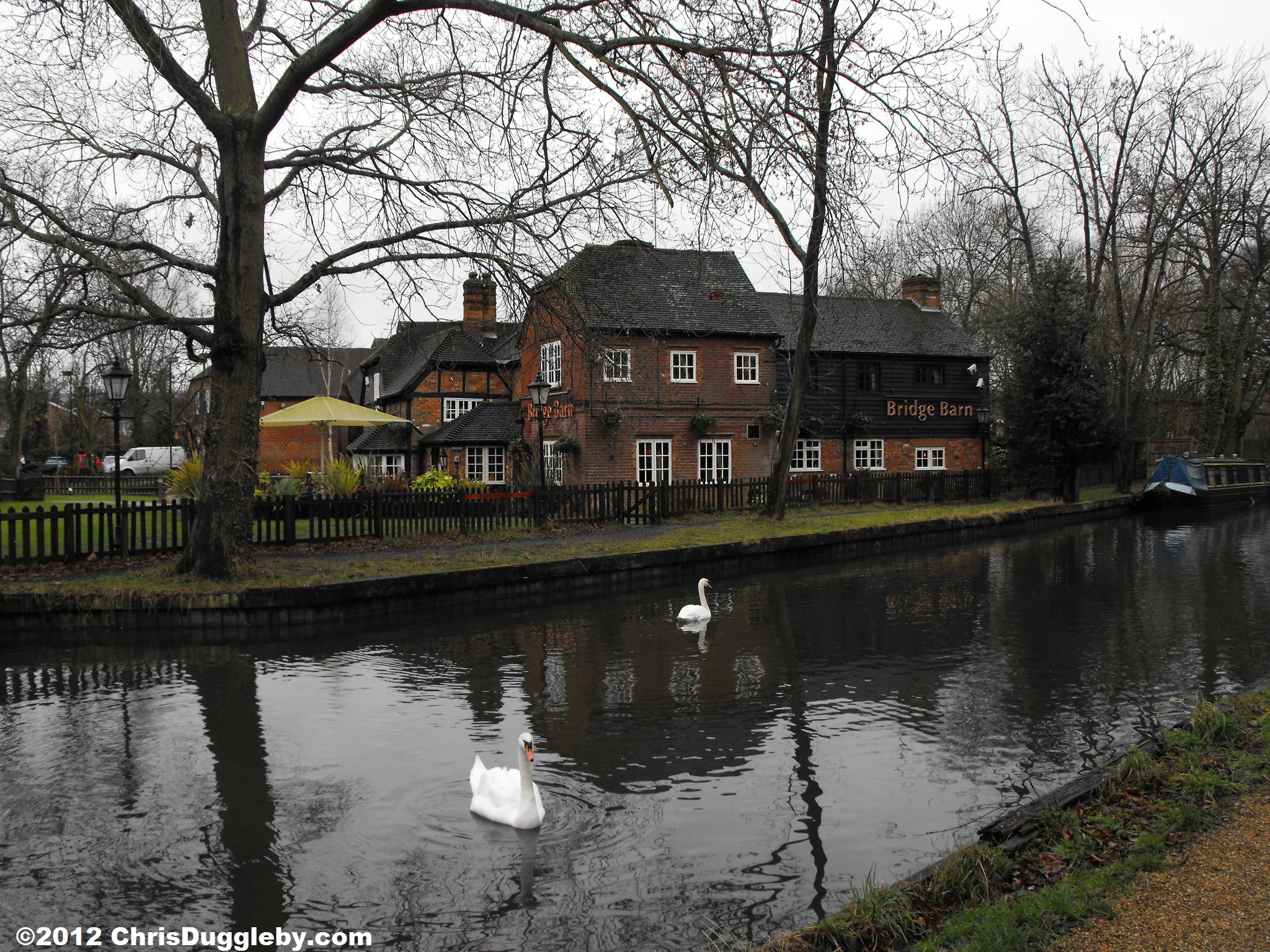
English Pub and Swans by Surrey Canal – April Scene by Chris Duggleby
Now, let me move to the third important reason to celebrate the 23rd April. This is the day when, in 1564, William Shakespeare was born. Interestingly it is also the day when, in 1616, he died. As the research into the Duggleby family tree highlighted it was much easier to be clear about dates of deaths hundreds of years ago than about dates of births. There were no birth records at that time, whereas the dates of deaths were usually written on gravestones and were also included on official documents like those confirming the reading of the last will and testament.
Therefore although 23rd of April was certainly the date when Shakespeare died, his date of birth was deduced in the main from two pieces of evidence. We know he was Baptized in the Holy Trinity Church in Stratford-upon-Avon on April 26th. According to the English Prayer Book at that time a baptism must occur no later than the Sunday, or other Holy day, after the birth. On his tomb it states he died on 23rd April 1616 aged 53. Since he was born in 1564 the presumption was made that he died on his birthday (if he had died before his birthday he should have been 52).
English Canal Scene to celebrate St. George’s day on 23rd April by Chris Duggleby
Whatever debate exists about his birth date the date of Shakespeare death is unquestionably 23rd April 1616. So get booking your 2016 hotel rooms in Stratford-upon-Avon and near the Globe theatre in London early. You may have noticed that the 500th anniversary of both Shakespeare’s death and the German Beer Purity Law fall on the same day? This will also be St George’s day. Anticipate some pretty ‘fluid’ celebrations.
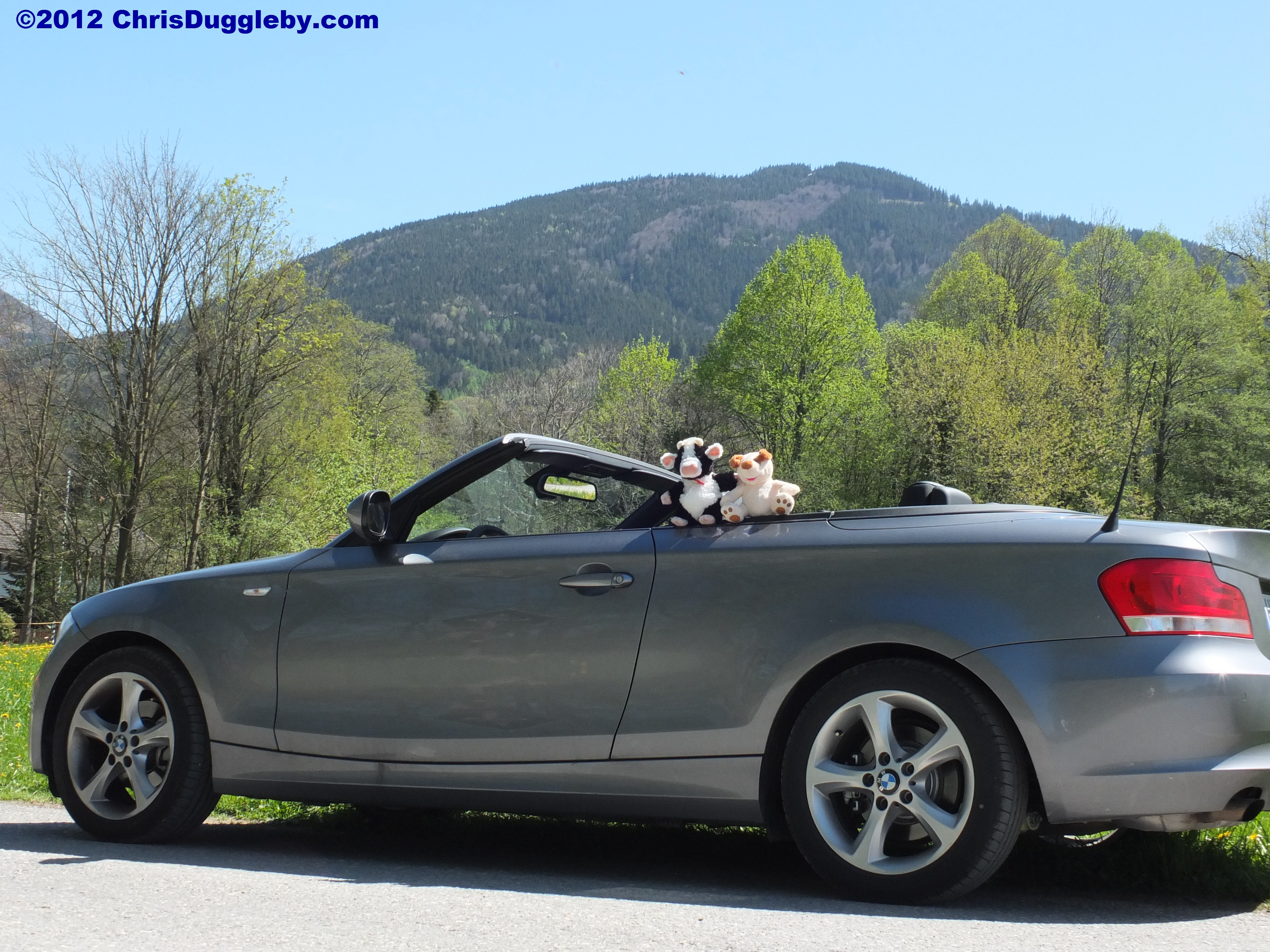
Moving on now to a less historical subject but one that is nevertheless very important those around me: this week RISKKO, my faithful guard dog, replied to an advertisement in the famous doggy music magazine the ‘Rolling Bone’. Uddele, the famous English singing cow, had placed an advertisement for a Rapper to join her in her next musical adventure. RISKKO is prolific when it comes to wrapping so he asked me to help him to reply. Low and behold within a couple of days Uddele turned up at our Alpine pad in her convertible BMW to interview RISKKO and carry out some sound trials in our music studio. There will be more on this exciting development in RISKKO’s music career next week but for now here is a picture of the two of them having fun in Uddele’s convertible (for once it was sunny!).
I bet you can’t wait until next week!
Uddele the Singing Cow (please note notAdele) visits RISKKO in her Silver Convertible Sports Car
If you found this article interesting you might also like to take a look at some of my other recent reviews. Just click on the titles below:
If you like this kind of news there are plenty more exciting articles on my Alpine Press contents page which you can find here. Why not add this site to your browser favourites or subscribe to get regular updates?
While you read the following article why not listen to my e-baroque compositions – just click on the box below:
or if techno music is more your cup of tea here are my techno/ambient compositions:
I hope you find the information below interesting…please visit chrisduggleby.com again.
This week I have decided that the blog entry should have a romantic flavour and there are two recent events that have reinforced my view that love is alive and kicking both in the Southern Hemisphere and also here ‘up North’.
Let’s start with the sunny end. Recently, Lorraine and Ian, the couple who live in the Villa next to my pad in Cape Town, decided to get married. Sadly because of an urgent assignment in another country with the RiskBusters I was unable to attend the wedding ceremony. I had to leave South Africa just as it was starting.
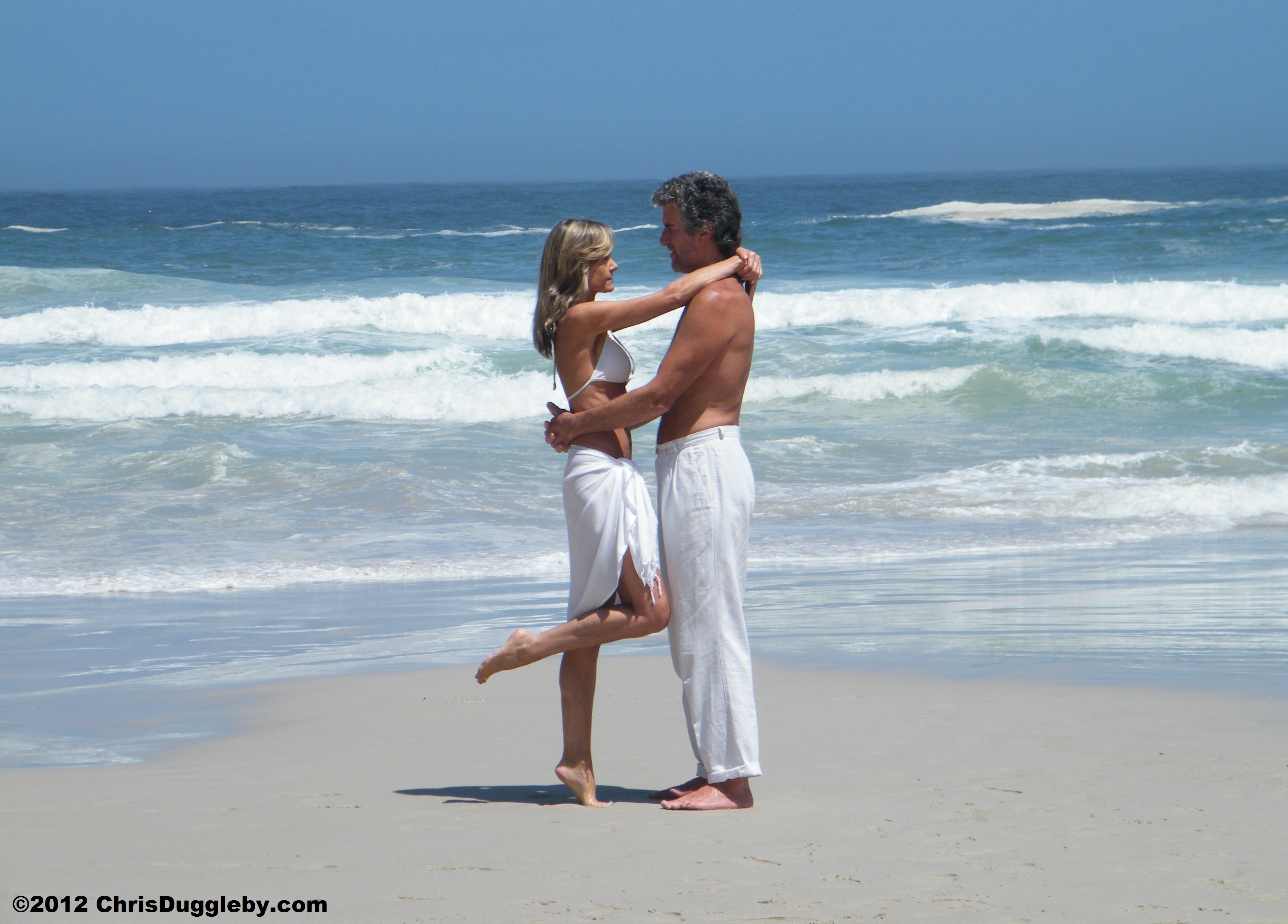
Just before the wedding – Lorraine and Ian strolling on Llandudno Beach
So, in order to participate ‘in spirit’ the love birds asked me if I would help them to put together some photos for the invitations. So the three of us trundled off down to Llandudno beach, camera in hand, and captured some sun and passion (despite getting sand into those inconvenient, itchy places).
Just before the wedding – one last look into your eyes on Llandudno Beach
This means that although I couldn’t be physically at the ceremony, I was involved indirectly. In fact I hear from the now happily married couple that they also decided to turn some of the photos into table mats. This means I can also join in whenever they have a romantic meal, looking into each other’s eyes, and perhaps inadvertently dribbling onto my lovely artwork!
With you in spirit if not in person!
Now, the second romantic event for this week’s blog was prompted when I turned up at the Car hire counter upon arrival at my usual alpine airport. Helga, the friendly lady at the counter, could hardly control her enthusiasm. “Mr Dog-I’ll-buy how luverly to experience your person coming again: I wud like to give you somezing extra special in der VIP carpark: Do you like Italian sports cars?”
I felt my pulse rising in anticipation but tried to stay cool: “Well only if they are red” I lied.
“Null Problemo! Der roof is red but if you don’t like it you can pull the nob and get off with it”
Even before I got to the car I had already sent a text to my partner, Pink Lips, who was waiting for me in the apartment: “Get your head scarf out, tomorrow we are going out in my Italian Sports Convertible”. I couldn’t wait to see what Helga wanted to give me in the VIP car park. Was it a Maserati GranCabrio or perhaps a Lamborghini Gallardo Spyder.
Riskko and Pink Lips enjoying the air in their new Italian Convertible
Next day Pink Lips was up at the crack of dawn, dressed in a bright red ribbon for her trip in the convertible. Even our dog RISKKO was already sitting in his basket with his tail wagging. So we waited for the rain to stop and then jumped into the masterpiece of Italian style and engineering craftsmanship. I hadn’t realised that the Fiat 500 was also available as a convertible.
By the time we got to the supermarket the rain had almost stopped, so while I was doing the shopping Pink Lips and RISKKO tried to work out how to get the roof down. Fortunately I had not left a can opener in the car.
RISKKO helps Pink Lips get the roof of the Italian Convertible down
I returned to the car with this weekend’s provisions and found that the two of them had succeeded in getting the roof down. They were showing off to the other shoppers in the supermarket car park and having a cuddle in their shiny brand new Italian convertible!
Sadly it started to rain again so we had to put the roof up and return home. Pink Lips asked me whether the Car Hire lady knew I was from Yorkshire – she had noticed the fuel gauge on my ‘sports’ car had hardly moved since I picked it up. We managed to get through a whole weekend of alpine touring and had only consumed about 14 litres of fuel. I explained it probably had something to do with the aerodynamic shape. I also pointed out that in Yorkshire we would probably add in a few design improvements like bigger side pockets for the ferrets (this would make it into a true ‘sports’ car). I would also have added a couple of straps at the front so it could be fastened onto the Donkey. This would improve the fuel consumption even further. Italian style and Yorkshire frugality!
At this point RISKKO decided to be sick in his basket. Time to go home.
If you haven’t seen their latest video yet just type RISKKO into You Tube or try this following link! Please note that some of the less respectable videos you might come across when you type Pink Lips into the search engine are not mine.
RISKKO and Pink Lips schmoozing in their new Italian Convertible
Have a romantic week!
Chris Duggleby
If you found this review interesting you may also find some of my other recent articles worth checking out. To view these simply click over the titles below:
(…..and the link to the Pink Lips You Tube video is here!)
If you find these articles interesting why not visit the contents list of my Alpine Press page and take a look at some of the other reviews, just click on the link here. Alternatively why not get free updates of new articles by subscribing to my RSS feed using this link. This will send the latest updates direct to your browser and you can read them at your leisure by looking under the ‘feeds’ section of your browser favourites.
Some people spend their weekends going shopping, visiting the local park or having a barbecue in the garden. I have rather more exciting hobbies like, for example, searching for cannibals in the woodlands around Surrey.
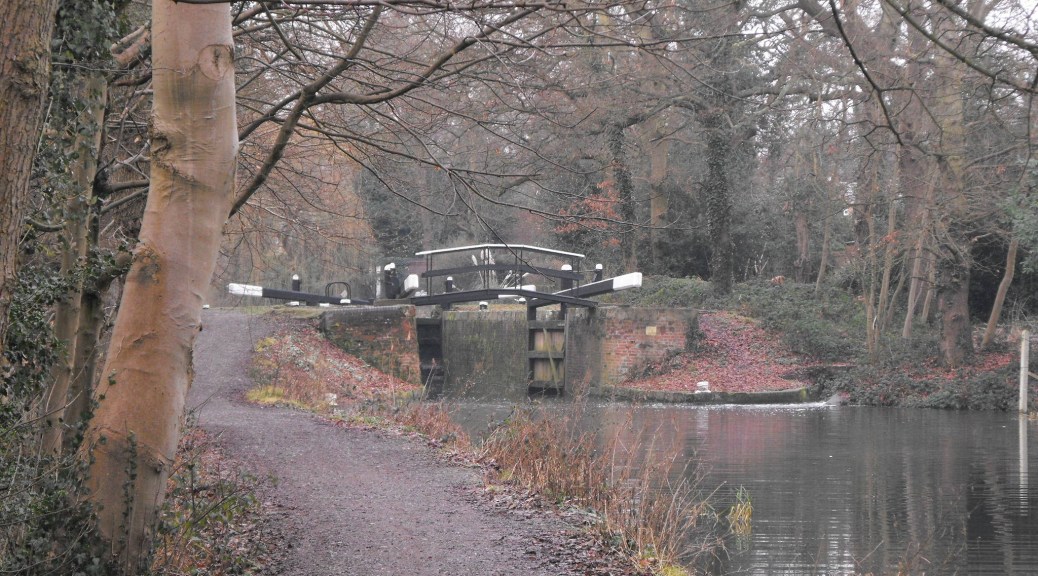
Bridge reflections over a Surrey canal: Woodham Locks on Basingstoke Canal, near Woking in Surrey (not far from the prehistoric burial mounds in Horsell Common).
Now you may ask, where did I get this interest in cannibalism? And what makes me think that I will find evidence of cannibals in the nice, quaint English countryside. Well if you remember from my Duggleby History page (from the menu above) the centre piece of the village of Duggleby in Yorkshire is a Neolithic ‘Barrow’ or 5000 year old prehistoric burial mound. This was surrounded by a man-made circular enclosure which can today only be seen using aerial or satellite imaging (see the Google map image below). It is believed that the positioning of this very large burial mound had something to do with a magical river, the Gypsey Race, which sporadically flowed from a series of springs nearby.
Excavations of the site uncovered the remains of ancient chieftains who were buried thousands of years ago as well as the bones of the animals which were eaten during what appeared to be very elaborate burial ceremonies. Interestingly some of these partly eaten remains were the bones of fellow humans leading to the conclusion that our ancestors, at least those in and around what is now the village of Duggleby, were Cannibals. As a descendant of that village I would like to think that the ancient art of eating ones neighbour was not just restricted to the village of Duggleby: hence my quest for other signs of ancient cannibalism in the UK.
As my UK base is in Surrey this seemed like a good enough place to start. My home overlooks the Basingstoke canal and I often journey along the canal path, past a couple of bridges, until I reach one of the many entrances to Horsell Common. As the ground is very springy in the common I can go jogging there without doing too much damage to my ageing knees. This can be tremendous fun, particularly when the locals are out training their un-tethered Rottweilers how to differentiate between nimble rabbits and old joggers’ legs.
My Horsell Common running track not far from where the Martians landed (from H.G.Wells’ book ‘War of the Worlds’)
One of my runs takes me past three Bronze Age barrows (burial mounds) which are believed to be over 4000 years old. They are thought to be the final resting place of Bronze Age nobility. These people had developed the art of making tools and weapons from bronze and had used these skills to reclaim the tree covered land for agricultural use. It is believed their cremated remains were buried underneath these barrows.
Close up of Woking’s Prehistoric Burial Mound in Horsell Common
The three burial mounds comprise of two bell barrows and one disc barrow. The picture above is of the larger bell barrow on the side of the common which is opposite the Monument Road car park. I took the photograph when there was some snow on the ground to emphasize the profile of the barrow. At the end of this blog entry I have also included a wider view photograph to give a better indication of the large size of this Bronze Age structure. The following photograph is of the sign at the entrance to the car park which shows the location of the three barrows and provides some information about their history. There is evidence they have been disturbed in the past by antiquarians or treasure hunters but there is no record of any remains or artefacts being found.
Sign for Bronze Age Barrows in Horsell Common
I find it particularly interesting to consider that the Duggleby Barrow and these Barrow’s in Horsell Common are separated by many hundreds of miles and yet clearly such structures appear to have been as common in Bronze age Britain as churches are today. This is all the more amazing when you remember that the population of the UK was considerably smaller then. Bell and Disc barrows are more commonly found in Wiltshire where sometimes they are in groups of 10 or more. They are very rare in Surrey and their presence in Horsell Common could be indicative that nobility migrated here from Wessex to develop the wooded land for agriculture. Unfortunately once the trees were removed the soil quality diminished giving rise to the Surrey Heathland.
Many people are aware that Woking hosted the UK’s first ‘modern’ cremation at the newly built ‘London’ crematorium in 1884. Few however realise that Woking (or Wochinges as it was called in the Domesday Book in 1086) was hosting formal cremation ceremonies 4000 years earlier. Below is a satellite picture which includes the larger bell barrow from my photograph (on the left) and the disc barrow to its right. The smaller bell barrow (on the other side of Monument road adjacent to the car park) cannot easily be seen from the air because it is now overgrown with trees.
As I rambled through this area (escaping from yet another Rottweiler!), I followed the path past the large Bell barrow in the direction away from the road and came across another interesting circular earth structure. This was also a ditch, albeit smaller than the other barrows but nonetheless quite distinctive. Perhaps there are other barrows in this area still waiting to be discovered? If you look at the wider aerial photograph below you may just be able to make out a circular structure towards the edge of the clearing in trees to the far left of the more pronounced circular ditch of the bell barrow. A large number of the more common round mound type of barrows have already been identified in Chobham common.
If you are interested in finding out more about prehistoric Burial Mounds in the UK there is a free booklet provided by the English heritage society: simply following this link and download the pdf file.
Clearly this exciting search for our prehistoric origins (and the quest to confirm I am not alone in being descended from cannibals) will continue…..
Over 4000 year old burial mound in Horsell Common, near Woking in Surrey
After another exciting week eradicating business risk with the RiskBusters the time arrived for my weekend vaunt into the mountains. Helga, the friendly car rental lady, was already dangling my key-ring on her finger as I approached her counter on arrival at the alpine airport. Hello Mister “Dog-I’ll-buy” I have something extra special to give you in the VIP car park this week.
Snow Back for April in Bavarian ‘Heidi’ Land
Perhaps at this point I should explain why Helga now refers to me as Mr. “Dog-I’ll-Buy”. After hearing many variations of her attempts to pronounce Duggleby I decided to make it a bit easier for her. I explained that my name was derived from my ancestor Sir Henry Dog-I’ll-Buy in the North of England. Sir Henry was King Richard the Lionheart’s official dog purchaser. The English Royal Family is famous for its love of dogs, especially Corgis. During the third Crusade whenever they arrived in a new town or village Sir Henry would go through the streets in front of the King shouting ‘Dog I’ll Buy, Dog I’ll Buy’. I explained to Helga that according to Welsh folklore the Corgi was the preferred mount of fairy warriors and King Richard paid especially well whenever Sir Henry found this magical companion for him.
As was common in the 12th century Sir Henry’s trade became his name. Over the centuries the name “Dog-I’ll-Buy” evolved into Duggleby. I showed her using Google Map the village in the North of England where Sir Henry and his descendants lived. Needless to say there are not many dogs there these days, especially Corgis.
Helga now pronounces my name almost perfectly and I appear to have become something of a celebrity within the airport car hire fraternity. They regularly ask me how are things in the royal dog trade.
So, you may ask, what special treat did Helga give me in the VIP car park? This week’s vehicle was an A3 Convertible. At this point I had no further need for a weekend weather forecast. I drove to my apartment in the dark, parked my little topless beauty and went to bed. The next morning I woke up to see that overnight the whole village had acquired a carpet of pristine white snow. Fortunately I had left the semi naked convertible in my garage.
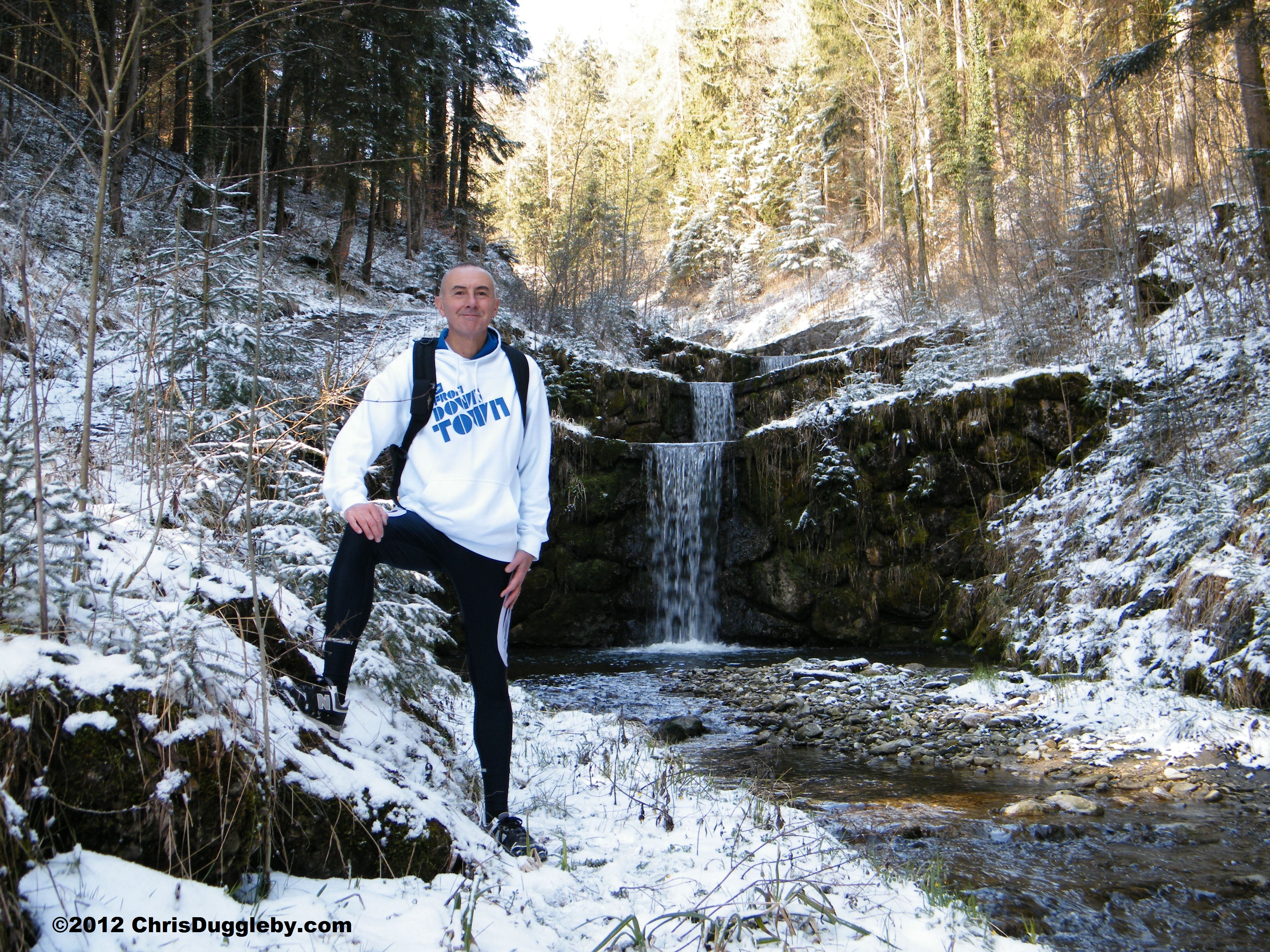
Although my alpine village gets lots of snow in the winter I manage to escape most of it due to my annual quest to find new sources of vitamin D in the southern hemisphere. This means that for me snow, in moderate doses, can be a bit of a treat. I slipped into some warm clothing, packed the tripod and camera into my rucksack, and headed up the local mountain stream to gets some photo’s of the snowy waterfalls.
Author (Chris Duggleby in tights!) by the Mountain ‘Bach’ (Bad Feilnbach Waterfalls, Bavaria)
It is amazing to think that a week earlier my son Pascal and I had been sitting in shorts and t-shirts in the garden of our local alpine restaurant. Compare this week’s pictures with the ones I published two weeks ago. Within the space of a week the temperatures had dropped over 20 degrees!
I decided that it would be sensible not to take the convertible to the local supermarket. My neighbours know that the Brits can be somewhat ‘interesting’ but I prefer not to overdo it. Just wait until I tell them the story about Sir Henry, official buyer of the King’s dogs!
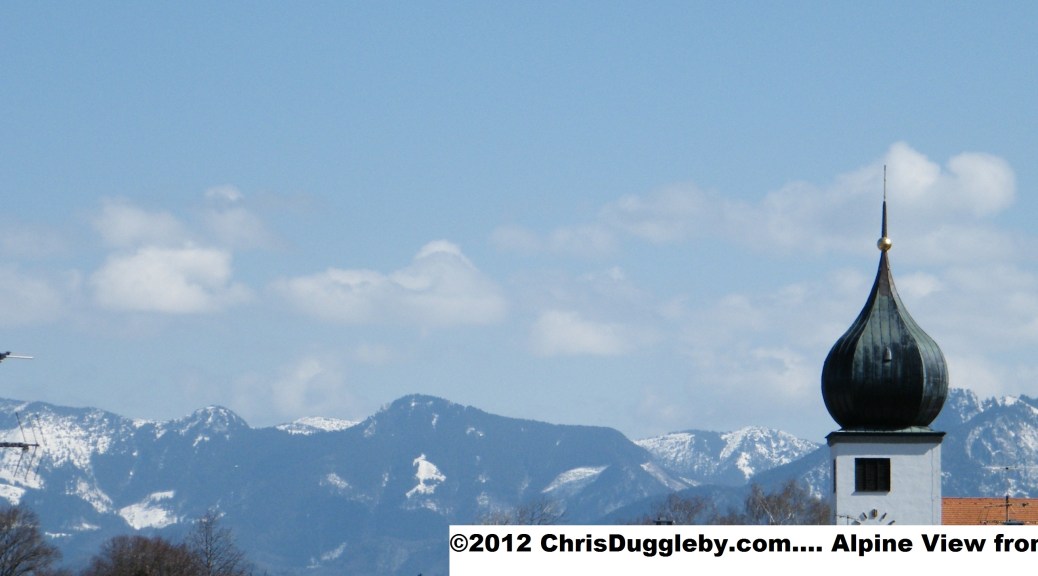
The Wendelstein mountain taken from the balcony – still snow capped, still beautiful
(There is actually another chapter to this story in which Sir Henry Dog-I’ll-Buy had to sell the Royal dogs to help Eleanor of Aquitaine raise the ransom demanded by Duke Leopold V of Austria. This unfriendly gentleman had imprisoned King Richard in Dürnstein Castle on his way back from the 3rd Crusade. The ransom money played a major part in financing the creation of Wiener Neustadt in 1194 – should be worth a few free drinks next time I visit Vienna).
Snow Back for April by the Bad Feilnbach Waterfalls (Spot the chilly head!)
P.S. Some dog related aspects of this story have been passed down through the family by word of mouth (and via my grandmothers rather messy recipe book) and therefore the documentary evidence may be rather suspect. The stuff that is properly evidence based can be found under the Duggleby History page – just click on the link here
While you read the following article why not listen to my e-baroque compositions – just click on the box below:
or if techno music is more your cup of tea here are my techno/ambient compositions:
I hope you find the information below interesting…please visit chrisduggleby.com again.
This week I am writing the blog from Surrey in the UK because while I am here at mission control there is a triple celebration.
First of all, my beautiful Spanish niece Estela has a birthday. Estela is the eldest daughter of my equally beautiful (and very fit) sister Helen. Helen carefully manages her time between teaching aerobics, having babies, running a home and a private transport service to the local schools. Although she has lots of aerobics customers she does not need any more transportation customers; she has seven of her own. It would be impossible to keep all of these activities going if she was not incredibly organised – in fact she is so organised she managed to make sure that child number seven was born on Estela’s birthday. No more dolls required! Estela has the real thing to play with. So we have a double Duggleby birthday celebration in Spain; Estela and Adam (he is in the photo sitting on Estela’s knee).
While Helen tries single handed (well not quite single) to make sure Spain has its fair share of the Duggleby genome we had another multiple birth celebration at RiskBuster’s mission control in the UK. ‘Herman’, a very tasty creation, was conceived a couple of weeks ago and within 10 days found himself given rise to a further eight offspring! Who is Herman? Well his formal title is ‘Herman the German Friendship Cake’. He was conceived as a batch of sourdough/yeast which was lovingly cared for by his Mummy (in other words he was regularly stirred and had various bits of cooking stuff done to him while he fermented). His ‘Mummy’, Gladys, is a bit shy so I promised no photos of her, just of her ‘masterpiece’.
Herman The German Friendship Cake: Conception
Then Herman was split into 8 portions and handed over to teams of RiskBusters who did yet more cooking stuff, and baked their baby Hermans into lots of highly imaginative cakes (by adding various different bits of cooking stuff). At the end of all this the RiskBusters paid lots of dosh to sample them and we had a voting competition to determine the best Herman (with categories like prettiest, cleverest, tastiest, sniffiest and other such artistic stuff). Needless to say all the money went to charity. Here are some picks of Herman’s conception, the arrival of the babies and their christening (just before being eaten – remember the bit in the Duggleby History page about the Brits descending from being cannibals!)
Herman The German Friendship Cake Gives Birth
You probably haven’t guessed it but I am not very familiar with cooking stuff; after 5 years in my place in England I still need to remove the Polystyrene packaging from the inside of my oven. If you want to find out more ‘technical’ details about making your own Herman I suggest you type “Herman the German Friendship Cake” into your search engine. Not only is it a super way to get people mixing (literally) but it was a good way to get the RiskBusters to part with their dosh for a good cause. In addition to Gladys a big thank you is deserved by Mildred who managed the promotional activities and counted (or better said ‘guarded’) the dosh.
I suspect you can hardly wait for the next blog entry……
Herman The German Friendship Cake Christening Party
Although this is only my second weekend in the mountains the recycling waste builds up quickly (helped by five months of junk mail in the post box). So on Sunday I made one of my regular trips to the local recycling centre. This is not any old waste centre – in fact I think this is one of the most scenic trips to the rubbish dump you can imagine. It is probably best to describe it using pictures so I made sure I took my camera – a bit of a challenge as it had to travel in the same rucksack as the rubbish.
Heidi Country – part of my extended but scenic trip to the local recycling centre.
My weekend alpine retreat is surrounded by mountains on three sides and is traversed by numerous mountain streams accompanied by their associated waterfalls. It is, in fact, a Spa resort and is well known for its ‘Wellness’ Clinics – we get many health tourists, especially in the summer. The local Authorities have gone to a lot of trouble to create lots of pleasant and interesting walks for visitors and residents. Many of these follow the streams. You guessed it: one of these walks happens to go from my house to the recycling centre!
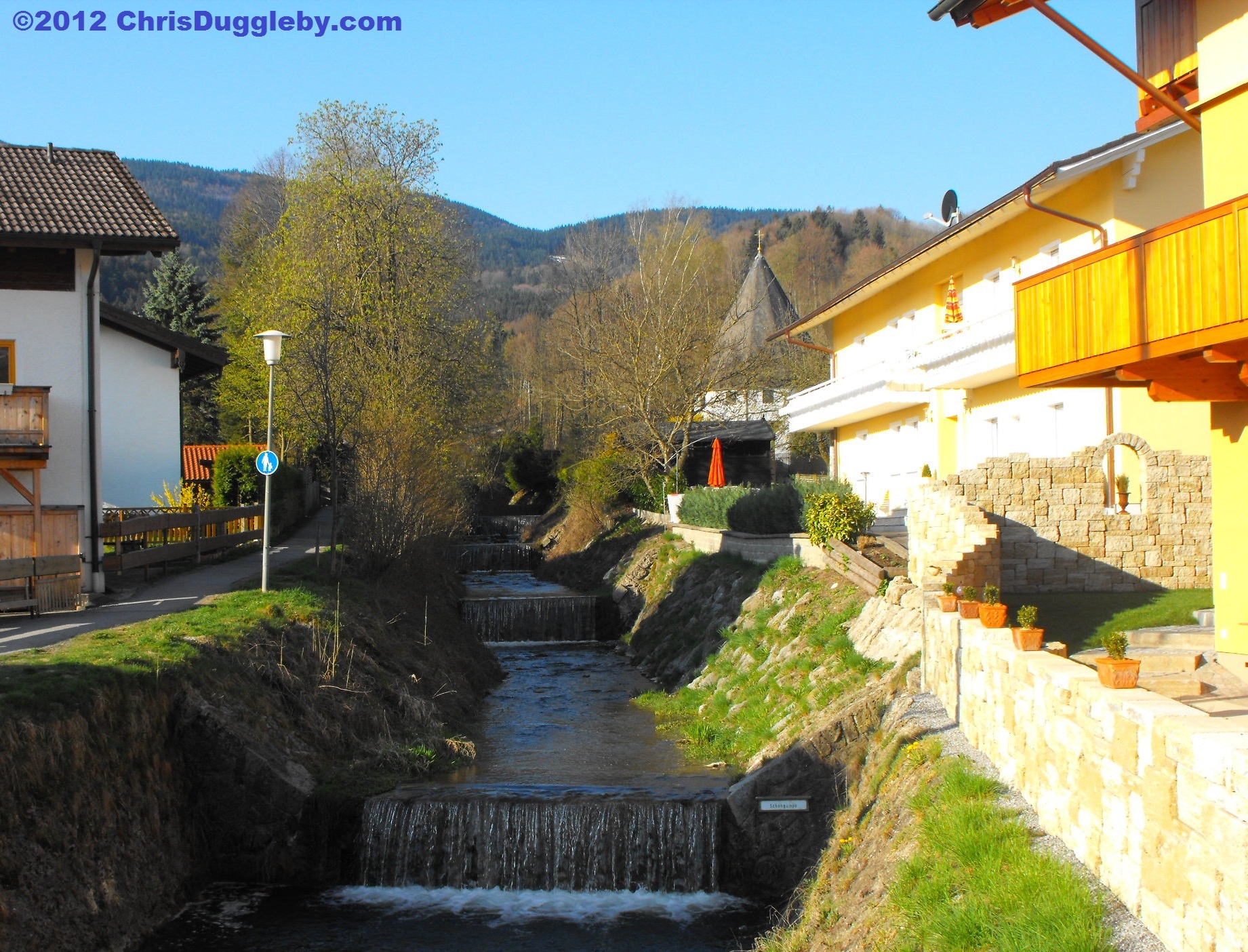
Alpine Stream which makes my trip to the Bad Feilnbach rubbish dump a pleasant experience
I normally follow the stream downhill to the ‘dump’ with my rucksack of rubbish (and camera) and then follow a more strenuous route home. The walk is important because on my less energetic weekends this, and a walk to the local supermarket, may be my only exercise (I will talk about the more energetic weekends in another blog entry).
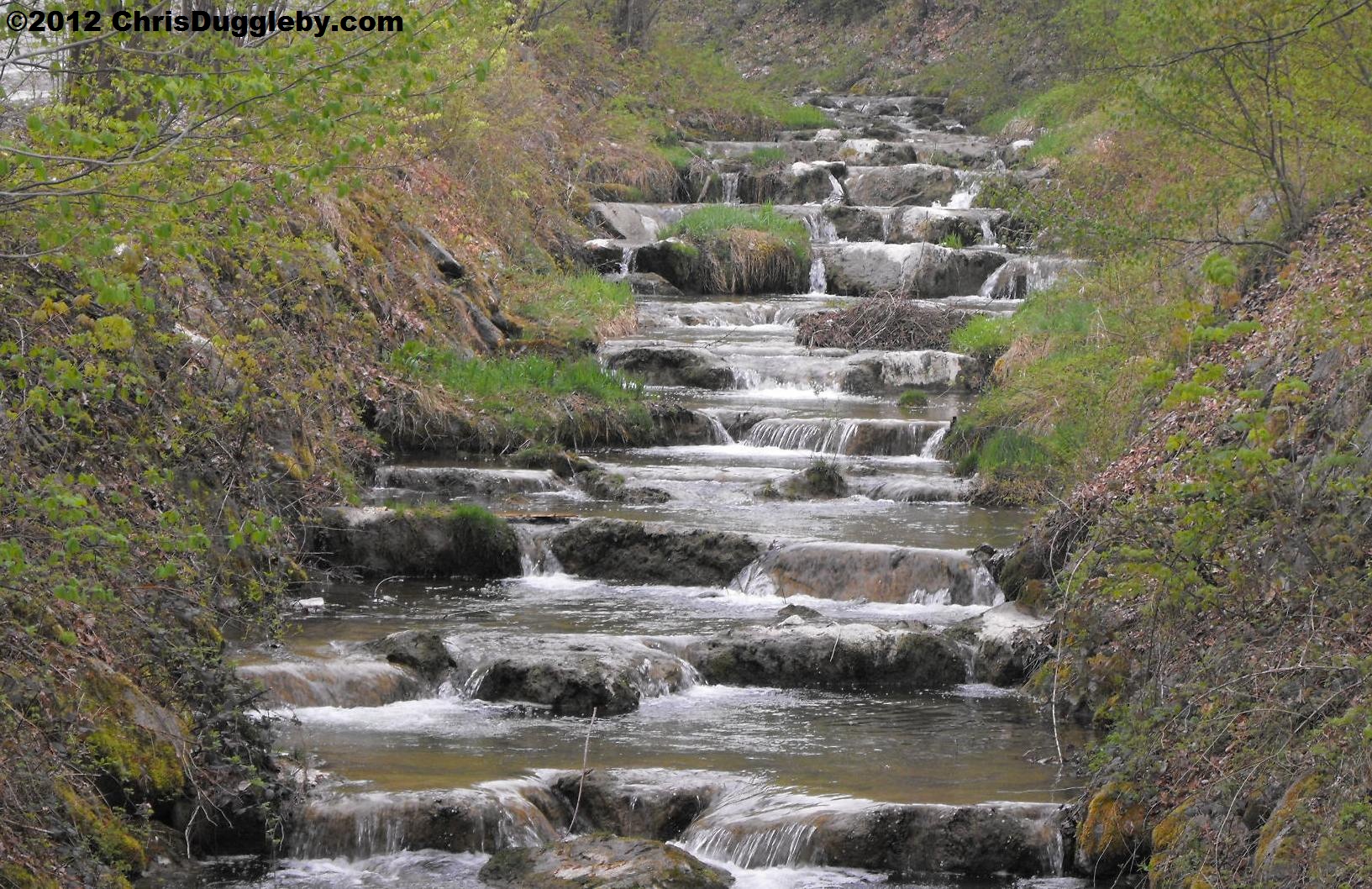
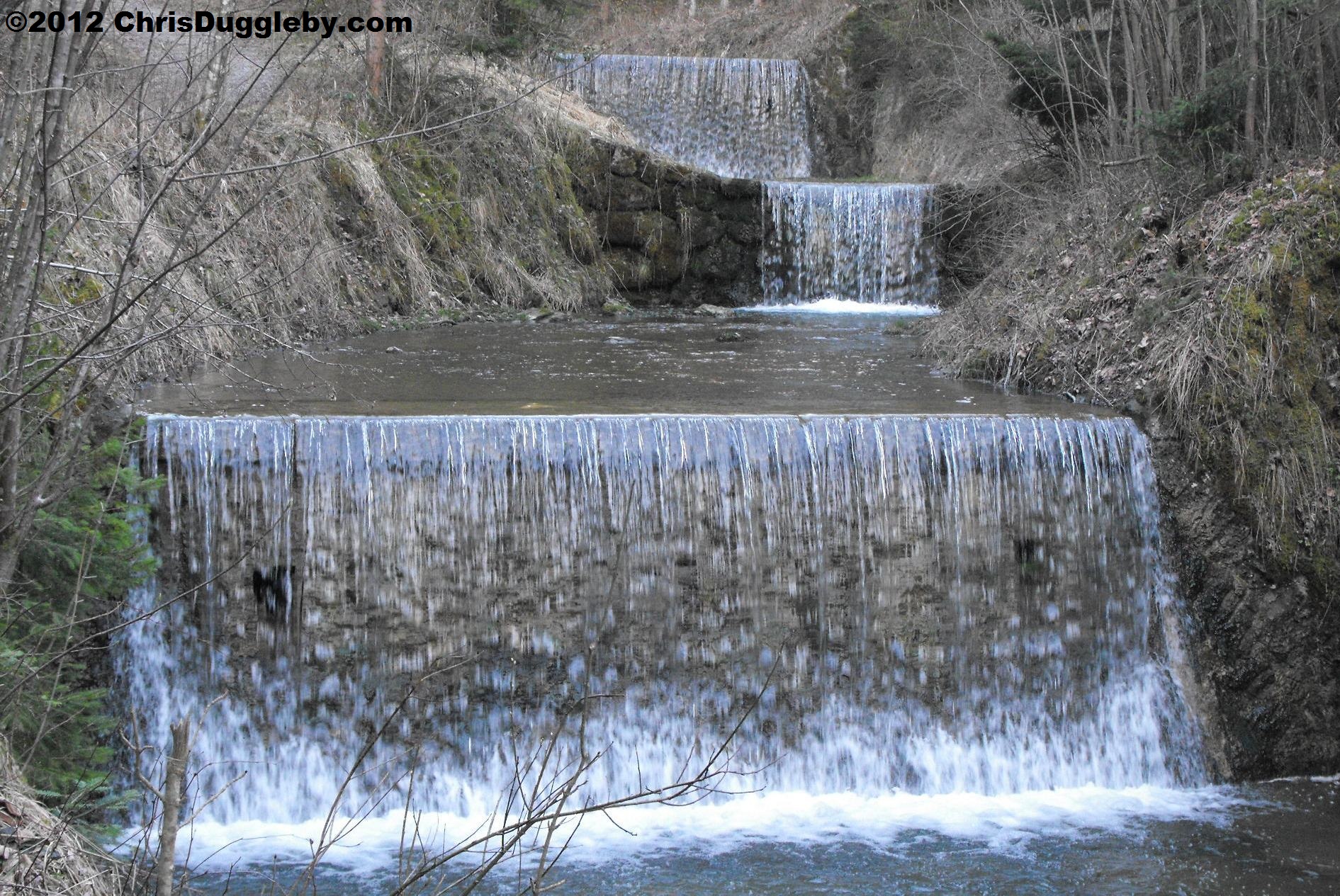
Cascade of waterfalls on the journey to the local recycling centre
On the return route I take a stroll up the hill through ‘Heidi’ country walking past the grazing cows with their rather noisy cowbells around their necks. This is not a bad idea as it is very easy for the cows to stray into the woods and get lost. My journey also takes me through a mountain forest rising gradually until I reach the mountain stream I followed earlier but higher up the mountain. I can then follow this all the way back down to my house. The many waterfalls along this mountain stream or ‘Bach’, together with the oxygen from the trees, create a very refreshing atmosphere.
Lake and waterfall on way back from the rubbish dump in Bad Feilnbach, Bavaria
The round trip to the waste centre takes about 90 minutes and in addition to doing my bit for the environment I feel that the mountain walk has ensured the environment has also done its bit for me. After this peace and tranquillity I am ready for another week of excitement with the RiskBusters in London pushing forward the frontiers of risk management in big business.
Not bad for a trip to the rubbish dump eh?
Until next time….
Chris Duggleby (Author) after doing his ‘bit’ for the environment (and his ageing body!)
Chris Duggleby (Author) getting some pre-Spring sun on the balcony in Bavaria
After a very hectic week in London at Mission Control with the ‘RiskBusters’ I was certainly ready to escape to the Alps on Friday evening. This was my first weekend excursion to the European mountains since the end of last October and as I stepped onto the flight it felt like I was going home. I was just about to put my bag into the overhead luggage compartment when a friendly voice from behind greeted me with: ‘Back from South Africa then – did you have a good time?’ It was one of the more hardy commuters between London and the Alps: one that didn’t escape to the south at the first sight of snow. This friendly greeting only served to reinforce my feeling of homecoming.
The welcome continued after I landed and I went to pick up my hire car – Ah Mr Doogelbuy (one of the name spellings you will not find in my ‘Duggleby’ history page), I have something special for you. The lady is always so nice that I just can’t bring myself to tell her that I actually prefer the small cheap cars….. I am trying to minimise fuel consumption!
Mountain stream and waterfalls running past the Alpine retreat in Bad Feilnbach, Bavaria
So within minutes of stepping off the plane I had picked up my ‘Panzer’ from the VIP parking area and was heading down the Autobahn trying to just gently ‘caress’ the gas pedal. After about 40 minutes, in the direction of Salzburg, I was in sight of the mountains. Suddenly a shooting star shot over the Autobahn in front of me! If there was any sadness left after my departure from Sunset Rocks last week the European gods were working hard to make it evaporate.
20 minutes later I found myself trying to manoeuvre the Panzer into my modestly sized garage. Fortunately the inbuilt parking sensors screamed at me as soon as I got too close to the walls. My neighbours had installed solar powered garden lights along the path to my front door. The path follows a mountain stream which runs by the side of the house. Somehow the pretty fairy lights and the sound of the water cascading over the waterfall just added to the magical atmosphere. The sky was free of any clouds allowing me to clearly see a carpet of stars twinkling above. Before long I had settled into my bed with the curtains wide open so I could fall asleep gazing at the stars.
View of the ‘Wendelstein’ from the Bedroom Window in the Bavarian Alps
Dawn broke much earlier than in the UK so after a very short lie-in I was quickly up and inspecting the apartment to see what had changed since I left. Everything was perfect: all the IT systems sprang into action (and more importantly the fridge and the kettle!). Before long I was listening to BBC radio via the i-Player and my screen players were re-playing my various photo collections. I may be something of an international gypsy but I do like to keep in touch with the UK music scene (and the British humour). At lunch time my younger son who lives nearby came over to pick up the socks which Daddy had purchased over in England. Both children prefer to get their socks and undies from a well known UK store. We enjoyed lunch in the garden of our ‘regular’ restaurant which overlooks the mountains. Although it was the middle of March the temperature was an incredible 20C (and certainly much warmer in the direct sunlight).
Three of the local Bavarian birds bending over backwards and doing a little dance to make me feel welcome!
The Chef came out to greet us with the almost obligatory ‘nice tan!’. He served up his latest speciality ‘Baeren Salat’ and we chatted about the weather. A few little personal niceties can make lunch so memorable! One of the simple reminders why, despite the challenges, I rush from work each Friday evening and fly half way across Europe.








































 Chris Duggleby